
Multi-Criteria Decision-Making Methodology for Ranking and Selecting Optimal Metaverse Platform
Abstract
This study adopted a decision-making model for ranking and section best Metaverse platforms. This section has various criteria such as effectiveness, safety, user experience, etc. So, the Multi-Criteria Decision-Making (MCDM) methodology is used to deal with multiple criteria. The Multi-Attributive Border Approximation area Comparison (MABAC) method is an MCDM methodology used to rank the alternatives. The proposed methodology is applied to nine criteria and fifteen alternatives. The criteria weights are computed. The sensitivity analysis is conducted to show the stability of the final rank. The ten cases in criteria weights are proposed, and ten ranks are shown. The results show the rank of alternatives under different cases is stable. The comparative analysis is conducted with other MCDM methods such as TOPSIS, VIKOR, EDAS, and COPRAS. The results show the proposed methodology is effective with other MCDM methods.
Keywords:Multi-criteria decision makingMetaverse platformSelection problemMulti-attributive border
approximation area comparison method.
1. Introduction
The term "Metaverse," first used in the 1992 Neal Stephenson book Snow Crash, is a relatively recent addition to technology experts' and scientists' everyday language. In Greek, "Meta" refers to a condition of existence that is higher or more sublime than what is now understood or experienced. Other levels of awareness or perception may be investigated and developed. A virtual environment that replaces the real world is called the "Metaverse" [1], [2].
It offers a complete Virtual Reality (VR) experience with well-known characters, objects, user interfaces, and social networks. [3] and [4] scholarly contributions support the definition in question, which states that the Metaverse possesses several essential characteristics, including a pervasive presence, absorbed verisimilitude, and the ability to grow in terms of player count, intricate settings, and a vast range of interactive possibilities. The Metaverse has evolved as an essential route for brand marketing, given the increasing virtual interaction of consumers during the pandemic. The younger generation is projected to show more interest in digital ownership after the epidemic. People's engagement in the Metaverse is as meaningful as how they interact with the world [5], [6]. The best possible realization of the Metaverse depends on high-speed internet access. The VR platform "Second Life" serves as an instructive example. It was established before cell phones were widely used, and its popularity declined partly because it did not allow instantaneous mobile interactions. Technologies that enable sophisticated interactions with people, digital objects, and settings are VR and augmented reality. The book presents the Metaverse as a virtual world, an internet-based cosmos that combines software agents and avatars to create augmented reality [7], [8]. The term "Metaverse" refers to a network of permanent, socially linked immersive platforms allowing smooth communication and dynamic interactions with virtual items. It depicts a Three-Dimensional (3D) depiction of a simulation that interacts with the natural world via a variety of applications [9], [10]. Multi-Criteria Decision-Making (MCDM) is one of the best tools for effective Metaverse platform selection to tackle such complicated challenges. In essence, MCDA came from operations research, which uses a variety of approaches but also has a humorous rational base from other fields of study [11], [12]. MCDA methods are widely used in both public and commercial sectors to inform choices on resource management in agriculture, immigration, education, transportation, investment, environment, defense, and health care, among other topics[13]–[15]. This study aims to propose an MCDM methodology named Multi-Attributive Border Approximation area Comparison (MABAC) for the section best Metaverse platform under different criteria.
2. Materials and Methods
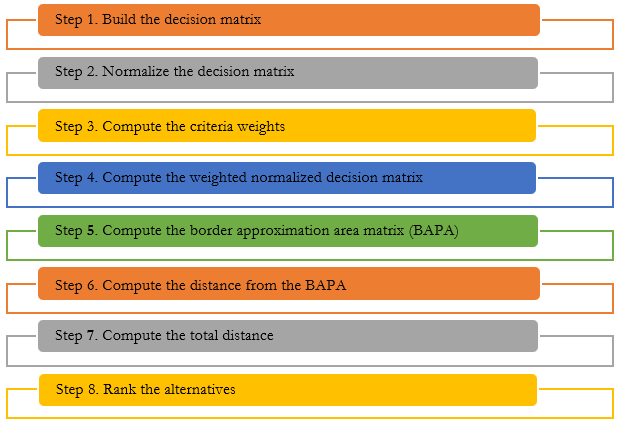
This section introduces the steps of the MABAC method. The MABAC method ranks the alternatives and selects the optimal option [16]–[18]. Fig. 1 shows the steps of the MABAC method.
Step 1. Build the decision matrix.
The experts and decision-makers build the decision matrix between criteria and alternatives. The experts used the crisp values between 1 and 9. The decision matrix is built using Eq. (1).
a11 ⋯ a1n
A = [ ⋮ ⋱ ⋮ ] , i = 1,2, … , m;j = 1,2, … , n. (1)
am1 ⋯ amn Step 2. Normalize the decision matrix.
The decision matrix is normalized for beneficial and non-beneficial criteria by using Eqs. (2) and (3).
aij − ai
yij = , i = 1,2, … , m, j = 1,2, … , n. (2)
ai − ai
aij − ai
y = , i = 1,2, … , m, j = 1,2, … , n. (3)
ij − +
ai − ai
where ai = max(a1, a2, … am) and ai = min(a1, a2, … am).
Step 3. Compute the criteria weights.
The weight criteria weights are computed using the average method. The experts and criteria are evaluated the criteria, and then the mean of their evaluation is computed to obtain the criteria weights.
Step 4. Compute the weighted normalized decision matrix.
The criteria weights are multiplied by the normalization matrix to obtain the weighted normalized decision matrix using Eq. (4).
tij = wj + yijwj, i = 1,2, … , m, j = 1,2, … , n. (4)
Step 5. Compute the Border Approximation Area matrix (BAPA).
The BAPA is computed by using Eq. (5).
BAPA = (∏ t ) , j = 1,2, … , n. (5)
j ij
Step 6. Compute the distance from the BAPA.
The distance from the BAPA is computed using Eq. (6).
dij = tij − BAPAj , i = 1,2, … , m. (6)
Step 7. Compute the total distance.
The total distance from the BAPAj is computed by using Eq. (7).
Fi = ∑ dij, i = 1, … , m. (7)
Step 8. Rank the alternatives.
The alternatives are ranked based on the total distance of Fi.
3. Results and Discussion
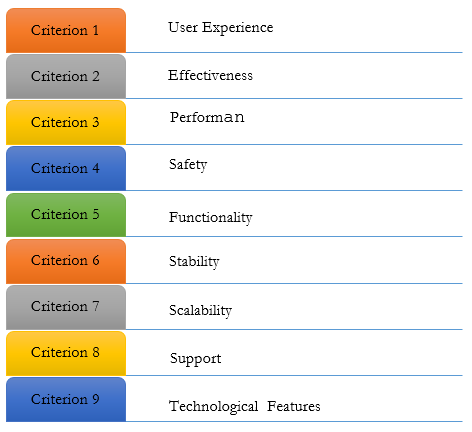
This section introduces the results of the MCDM methodology to select the optimal Metaverse platform among various criteria and alternatives. The experts and decision-makers evaluated the nine criteria and 15 platforms. Fig. 2 shows the list of criteria.
Step 1. Build the decision matrix.
The experts and decision-makers build the decision matrix between criteria and alternatives. The experts used the crisp values between 1 and 9. The decision matrix is built using Eq. (1).
Step 2. Normalize the decision matrix.
The decision matrix is normalized for beneficial and non-beneficial criteria by using Eqs. (2) and (3) as shown in Table 1.
Table 1. The normalization decision matrix.
This table is shown in the PDF version of the article.
Step 3. Compute the criteria weights.
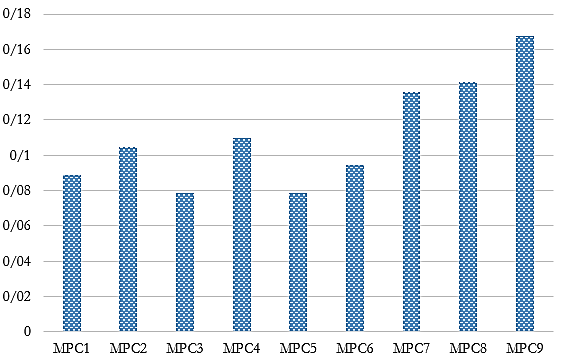
The weight criteria weights are computed using the average method. The experts and criteria are evaluated the criteria, and then the mean of their evaluation is computed to obtain the criteria weights. Fig. 3 shows the criteria weights.
Step 4. Compute the weighted normalized decision matrix.
The criteria weights are multiplied by the normalization matrix to obtain the weighted normalized decision matrix using Eq. (4), as shown in Table 2.
Table 2. The weighted normalized decision matrix.
This table is shown in the PDF version of the article.
The BAPA is computed by using Eq. (5).
MPC4 MPC5 MPC6 MPC7 MPC8 MPC9
0.188482 0.100972 0.141361 0.233358 0.262528 0.263276 0.125654 0.078534 0.125654 0.194465 0.262528 0.335079 0.157068 0.100972 0.172775 0.252805 0.222139 0.335079 0.172775 0.112191 0.094241 0.213912 0.201945 0.311144 0.109948 0.089753 0.109948 0.194465 0.141361 0.215408 0.125654 0.112191 0.157068 0.136126 0.282723 0.167539 0.172775 0.123411 0.094241 0.155572 0.222139 0.191473 0.219895 0.078534 0.188482 0.213912 0.161556 0.239342 0.204188 0.100972 0.094241 0.272251 0.201945 0.28721 0.157068 0.157068 0.109948 0.252805 0.141361 0.215408 0.172775 0.112191 0.157068 0.194465 0.282723 0.311144 0.141361 0.078534 0.141361 0.252805 0.222139 0.263276 0.172775 0.100972 0.141361 0.272251 0.161556 0.335079 0.172775 0.100972 0.141361 0.213912 0.141361 0.239342 0.204188 0.13463 0.125654 0.194465 0.222139 0.167539
Step 6. Compute the distance from the BAPA.
The distance from the BAPA is computed using Eq. (6). As shown in Table 3.
Table 3. The distance matrix.
This table is shown in the PDF version of the article.
Step 7. Compute the total distance.
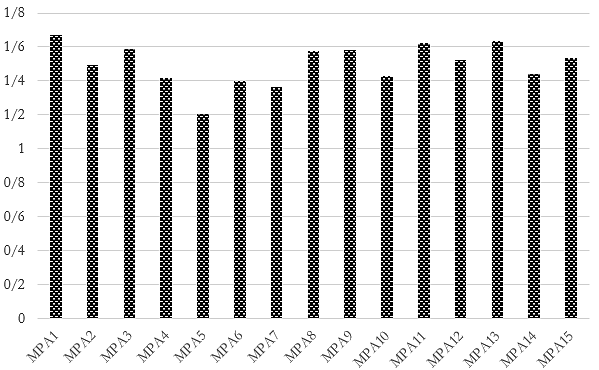
The total distance from the BAPAj is computed using Eq. (7), as shown in Fig. 4.
Step 8. Rank the alternatives.
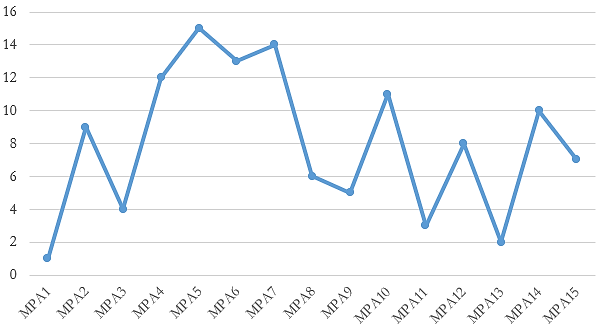
The alternatives are ranked based on the total distance of Fi as shown in Fig. 5. Alternative 1 is the best, and alternative 5 is the worst.
4. Sensitivity Analysis
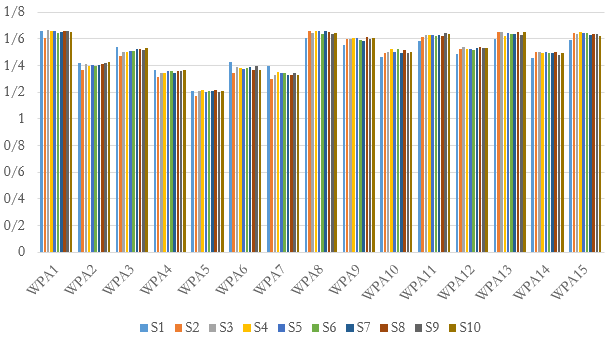
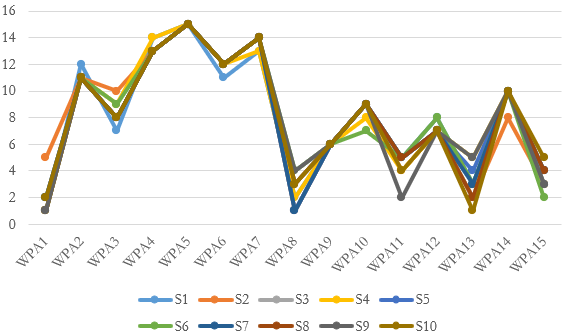
This section shows the rank of alternatives under different cases in criteria weights. We proposed ten cases in criteria weights. Fig. 6 shows the ten instances in criteria weights. Fig. 7 shows the rank of alternatives under different cases. The results show the rank of other options is stable.
5. Comparative Analysis
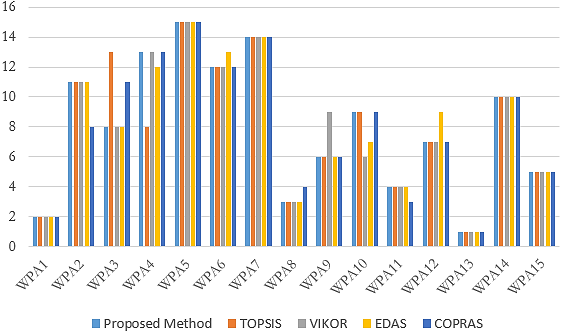
In this section, we compare the MCDM methodology with other MCDM methods, such as TOPSIS, VIKOR, EDAS, and COPRAS methods, to show the effectiveness of the proposed MCDM methodology. Fig. 8 shows the rank of alternatives under comparative analysis. The results show the proposed method is robust compared with other MCDM methods.
6. Conclusion
The Metaverse platforms are evaluated, and the optimal one is selected among various criteria. The MCDM methodology is used to deal with multiple criteria. The MABAC method is used as an MCDM methodology to rank the alternatives. The nine criteria and 15 alternatives are used in this study. The experts and decision-makers evaluate the requirements and options based on their opinions. Then, this study used a crisp value from 1 to 9 to assess the criteria and alternatives to build the decision matrix. The decision matrix is normalized based on the positive and negative criteria. This study used all positive requirements. The criteria weights are computed by using the mean method. The criteria weights multiply the normalization matrix to show the weighted normalization decision matrix. The results show that alternatives 13 and 5 are the best.
Funding
No specific funding was received for this study.
Conflicts of Interest
The authors declare no conflicts of interest regarding the publication of this paper.
References
- [1] Jeon, J. E. (2021). The effects of user experience-based design innovativeness on user-metaverse platform channel relationships in South Korea. Journal of distribution science, 19(11), 81–90. https://doi.org/10.15722/jds.19.11.202111.81
- [2] Kim, J. G. (2021). A study on metaverse culture contents matching platform. International journal of advanced culture technology, 9(3), 232–237. https://doi.org/10.17703/IJACT.2021.9.3.232
- [3] Periyasami, S., & Periyasamy, A. P. (2022). Metaverse as future promising platform business model: Case study on fashion value chain. Businesses, 2(4), 527–545. https://doi.org/10.3390/businesses2040033
- [4] Yoo, G. S., & Chun, K. (2021). A study on the development of a game-type language education service platform based on metaverse. Journal of digital contents society, 22(9), 1377–1386. (In Korean). http://dx.doi.org/10.9728/dcs.2021.22.9.1377
- [5] Han, J., Heo, J., & You, E. (2021). Analysis of metaverse platform as a new play culture: Focusing on roblox and zepeto. International conference on human-centered artificial intelligence (pp. 1–10). Éditions diffusion presse sciences. https://doi.org/10.1051/shsconf/202420001016
- [6] Jovanović, A., & Milosavljević, A. (2022). VoRtex Metaverse platform for gamified collaborative learning. Electronics, 11(3), 317. https://doi.org/10.3390/electronics11030317
- [7] Gwak, H. G., & Shin, D. H. (2023). The effect of Metaverse platform-based. Journal of Korean elementary science education, 42(2), 385–397. (In Korean). https://doi.org/10.15267/keses.2023.42.2.385
- [8] Jeong, H., Yi, Y., & Kim, D. (2022). An innovative e-commerce platform incorporating metaverse to live commerce. International journal of innovative computing, information and control, 18(1), 221–229. http://dx.doi.org/10.24507/ijicic.18.01.221
- [9] Park, S., & Kang, Y. J. (2021). A study on the intentions of early users of metaverse platforms using the technology acceptance model. Journal of digital convergence, 19(10), 275–285. (In Korean). https://doi.org/10.14400/JDC.2021.19.10.275
- [10] Ko, H., Jeon, J., & Yoo, I. (2022). Metaverse platform-based flipped learning framework development and application. Journal of the Korean association of information education, 26(2), 129–140. (In Korean). https://doi.org/10.14352/jkaie.2022.26.2.129
- [11] Lukić, R. (2021). Application of MABAC method in evaluation of sector efficiency in Serbia. Revista de management comparat internațional, 22(3), 400–418. http://dx.doi.org/10.24818/RMCI.2021.3.400
- [12] Jia, F., Liu, Y., & Wang, X. (2019). An extended MABAC method for multi-criteria group decision making based on intuitionistic fuzzy rough numbers. Expert systems with applications, 127(1), 241–255. http://dx.doi.org/10.1016/j.eswa.2019.03.016
- [13] Pamučar, D., Petrović, I., & Ćirović, G. (2018). Modification of the best–worst and MABAC methods: A novel approach based on interval-valued fuzzy-rough numbers. Expert systems with applications, 91, 89–
- [106] https://doi.org/10.1016/j.eswa.2017.08.042
- [14] Torkayesh, A. E., Tirkolaee, E. B., Bahrini, A., Pamucar, D., & Khakbaz, A. (2023). A systematic literature review of MABAC method and applications: An outlook for sustainability and circularity. Informatica, 34(2), 415–448. https://doi.org/10.15388/23-INFOR511
- [15] Wei, G., Wei, C., Wu, J., & Wang, H. (2019). Supplier selection of medical consumption products with a probabilistic linguistic MABAC method. International journal of environmental research and public health, 16(24), 5082. https://doi.org/10.3390/ijerph16245082
- [16] Alinezhad, A., Khalili, J., Alinezhad, A., & Khalili, J. (2019). MABAC method. In New methods and applications in multiple attribute decision making (MADM) (pp. 193–198). Springer. http://dx.doi.org/10.1007/978-3-030-15009-9
- [17] Wang, J., Wei, G., Wei, C., & Wei, Y. (2020). MABAC method for multiple attribute group decision making under q-rung orthopair fuzzy environment. Defence technology, 16(1), 208–216. https://doi.org/10.1016/j.dt.2019.06.019
- [18] Sun, R., Hu, J., Zhou, J., & Chen, X. (2018). A hesitant fuzzy linguistic projection-based MABAC method for patients’ prioritization. International journal of fuzzy systems, 20, 2144–2160. https://doi.org/10.1007/s40815-017-0345-7