
A New Approach for Solving Fuzzy Cooperative Continuous Static Games
Abstract
This study explores Cooperative Continuous Static Games (CCSGs) characterized by fuzzy cost functions that are piecewise quadratic. It introduces an effective approximation technique, specifically the close interval approximation for Piecewise Quadratic Fuzzy Numbers (PQFNs). The paper employs the weighted Tchebycheff method to derive an optimal compromise solution and establishes the corresponding stability set of the first kind. Additionally, a numerical example is provided to illustrate the effectiveness of the proposed method in computational terms.
Keywords:Cooperative continuous static gamesClose interval approximationPiecewise quadratic fuzzy numbersα-efficient solutionWeighted Tchebycheff methodOptimal compromise solutionStability
1. Introduction
The possibility of competition among the system controllers is called ''Players,'' the optimization problem under consideration is therefore termed a ''Game''. Each player in the game controls a specified subset of the system parameters (Called his/her control vector) and seeks to minimize his/her own scaler cost criterion subject to specified constraints. Game theory applications may be found in economics, engineering, biology, etc.
Three major classes of games are:
The three basic solution concepts for the games are [1]:
− Nash equilibrium solutions − Min-max solutions − Pareto minimal solutions
In many scientific areas, such as system analysis and operator research, a model has to be setup-using data, which is only approximately known. Fuzzy sets theory, introduced by Zadeh [2], makes this possible. Fuzzy numerical data can be represented by employing fuzzy subsets of the real line, known as fuzzy numbers. Dubois and Prade [3] extended the use of algebraic operations on real numbers to fuzzy numbers by use of a fuzzification principle. Despite vast decision-making experience, the decision-maker cannot articulate the goals precisely. Decision-making in a fuzzy environment, developed by [4], improved and is a great help in managing decision problems. Zimmermann [5] proposed the fuzzy set theory and its applications.
Orlovski [6] studied Multi-Objective Nonlinear Programming (MONLP) problems with fuzzy parameters. Osman and El-Banna [7] introduced the stability of fuzzy MONLP. Many pieces of research have been introduced in Cooperative Continuous Static Games (CCSGs) [8]–[11].
In his earlier work, Osman [12], [13] analyzed the notions of the solvability set, stability set of the first kind, and stability set of the second kind for parametric convex nonlinear programming.
In this paper, Fuzzy Cooperative Continuous Static Games (F-CCSG) are introduced. The weighted Tchebycheff method is applied to obtain the optimal compromise solution.
The remainder of the paper is organized as follows: Section 2 introduces some preliminaries needed in this paper. Section 3 formulated the mathematical model for the continuous cooperative static games. Section 4 proposed a solution approach for obtaining an optimal compromise solution. Section 5 gives a numerical example for illustration. Finally, some concluding remarks are reported in section 6.
2. Preliminaries
To discuss the problem easily, it recalls basic rules and findings related to fuzzy numbers, Piecewise Quadratic Fuzzy Numbers (PQFNs), close interval approximation, and its arithmetic operations.
Definition 1 ([2]). Fuzzy number: A fuzzy number A ̃ is a fuzzy set with a membership function defined as πA ̃(x): ℜ → [0,1], and satisfies:
I. A ̃ is fuzzy convex, i.e., π (δ x + (1 − δ) y) ≥ min{π (x), π (y) }; for all x, y ∈ ℜ; 0 ≤ δ ≤ 1.
A ̃ A ̃ A ̃
II. A ̃ is normal, i.e., ∃ x ∈ ℜ for which π (x ) = 1.
0 A ̃ 0
III. Supp (A ̃) = {x ∈ ℜ: π (x) > 0 } is the support of A ̃.
IV. π (x) is an upper semi-continuous (i. e., for each α ∈ (0,1), the α-cut set A ̃ = {x ∈ ℜ: π ≥ α} is closed.
A ̃ α A ̃
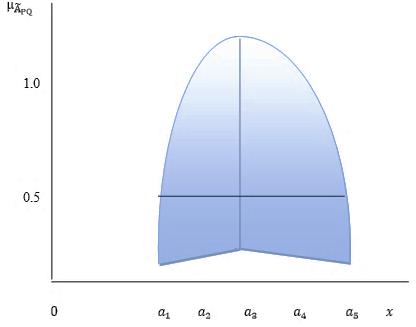
Definition 2 ([14]). A PQFN is denoted by A ̃ = (a , a , a , a , a ), where a ≤ a ≤ a ≤ a ≤ a are real
PQ 1 2 3 4 5 1 2 3 4 5
numbers and is defined by if its membership function μa ̃ is given by (Fig. 1).
PQ 0, x < a1, (x − a1) , a1 ≤ x ≤ a2, ( )2 2 a2 − a1 (x − a3) + 1, a2 ≤ x ≤ a3, ( )2 2 a3 − a2 μA ̃ = PQ 1 1 (x − a3) + 1, a3 ≤ x ≤ a4, ( )2 2 a4 − a3 (x − a5) , a4 ≤ x ≤ a5, ( )2 2 a5 − a4 {0, x > a5.
Definition 3 ([14]). Let A ̃ = (a , a , a , a , a ) and B ̃ = (b , b , b , b , b ) be two PQFNs. The arithmetic
PQ 1 2 3 4 5 PQ 1 2 3 4 5
operations on A ̃ and B ̃ are:
PQ PQ
I. Addition: A ̃ (+)B ̃ = (a + b , a + b , a + b , a + b , a + b ).
PQ PQ 1 1 2 2 3 3 4 4 5 5
II. Subtraction: A ̃ (−)B ̃ = (a + b , a + b , a + b , a + b , a + b ).
PQ PQ 1 5 2 4 3 3 4 2 5 1
(k a1, k a2, k a3, k a4, k a5), k > 0, III. Scalar multiplication: kA ̃ = {
PQ
(k a5, k a4, k a3, k a2, k a1), k < 0.
− + ̃
Definition 4 ([14]). An interval approximation [A] = [aα, aα] of a PQFN A is called closed interval approximation if: aα = inf{x ∈ ℝ: μA ̃ ≥ 0.5}, and aα = sup{x ∈ ℝ: μA ̃ ≥ 0.5}.
Definition 5 ([14]). Associated ordinary numbers [14]. If [A] = [aα, aα] is the close interval approximation
aα+ aα
of PQFN, the Associated ordinary number of [A] is defined as A ̂ = .
− + − +
Definition 6 ([14]). Let [A] = [aα, aα], and [B] = [bα, bα ] be two interval approximations of PQFN. Then the arithmetic operations are:
− − + +
I. Addition: [A](+)[B] = [aα + bα , aα + bα ].
− + + −
II. Subtraction: [A](−)[B] = [aα − bα , aα − bα].
[α aα, α aα], α > 0, III. Scalar multiplication: α [A] = { [ α aα, α aα], α < 0.
+ − − + − − + +
aα bα+aα bα aα bα+aα bα
IV. Multiplication: [A](×)[B]=[ , ].
aα aα − +
[2 ( ) , 2 ( )], [B] > 0, bα + bα ≠ 0,
− + − +
bα+bα bα+bα
V. Division: [A](÷)[B]={
aα aα − +
[2 ( ) , 2 ( )], [B] < 0, bα + bα ≠ 0.
− + − +
bα+bα bα+bα
VI. The order relations:
− − + + − + − +
− [ ](≲)[ ] if ≤ and ≤ or + ≤ + .
− − + +
− [ ] is preferred to [ ] if and only if ≥ , ≥ .
It is noted that P(ℝ) ⊂ F(ℝ)t, where F(ℝ), and P(ℝ) are the sets of all PQFNs and close in interval approximation of PQFN, respectively.
3. Problem Formulation and Solution Concepts
Consider the following F-CCSGs with n-players having piecewise quadratic fuzzy parameters in the cost functions of the players. These players respectively have the costs.
Fuzzy cooperative continuous static games
G1(b, , ξ, a ̃1), G2(b, ξ, a ̃1), … , Gm(b, ξ, a ̃m), (1)
gj(b, ξ) = 0, j = 1, n, (2) ξ ∈ Ω = {ξ ∈ ℜ : hl(b, ξ) ≥ 0, l = 1, r}, (3)
where Gi(b, ξ, a ̃i), ji = 1, m are convex functions on ℜ × ℜ , hl(b, ξ), l = 1, r are concave functions on
n s n s
ℜ × ℜ , gj(b, ξ), j = 1, n are convex functions on ℜ × ℜ Assume that there exists a function b = f(ξ). If the
∂gj(b,ξ)
function gj(b, ξ) = 0, j = 1, n are differentiable than the Jacobian | | ≠ 0, j; q = 1, n in the neighborhood
∂bq
of a solution point (b, ξ) to Eq. (2), b = f(ξ) is the solution to Eq. (2) generated by ξ ∈ Ω; differentiability assumptions are not needed here for all the functions Gi(b, γ, a ̃i), i = 1, n and hl(b, ξ), Ω is a regular and compact set. a ̃i, i = 1, m, represents a vector of PQFNs [14]. Let a ̃1, a ̃2, … , a ̃m; μa ̃ (a1), μa ̃ (a2) … , μa ̃ (am) be
1 2 m
the PQFNs in the F-CCSG problem with convex membership functions, respectively.
For a certain degree of α, the F-CCSG problem can be rewritten in the following fuzzy form [15], [16]: -cooperative continuous static games
G1(b, ξ, a1), G2(b, ξ, a2), … , Gn(b, γ, am), (4)
gj(b, ξ) = 0, j = 1, 2, … , n, (5) s (6)
Ω = {ξ ∈ ℜ : hl(b, ξ) ≥ 0, l = 1, r},
a ∈ L (a ̃ ), i = 1, m. (7)
i α i
Definition 7 ([1]). Let b = f(ξ) be the solution to Eq. (5) generated by ξ ∈ Ω. A point ∈ Ω is called an α-Pareto optimal solution to the α-CCSG problem, if and only if there does not exist (ξ, a) ∈ Ω × Lα(a ̃i) such that:
∗ ∗ ∗ ∗ ∗
Gi(f(ξ), ξ, ai) ≤ Gi(f(ξ ), ξ , ai ); for all i = 1, m and Gi(f(ξ), ξ, ai) < Gi(f(ξ), ξ , ai ) for some i ∈ {1, 2, … , m}, where ai are called α-level minimal parameters.
From the α-Pareto optimal solution to the α-CCSG problem concept, one can show that a point ξ ∈ Ω is an α-Pareto minimal solution to the α-CCSG problem if and only if ξ is an α-Pareto minimal solution to the following α-multi-objective optimization problem:
α-MOP
min(G (ξ, a ), G (ξ, a ), … , G (ξ, a )) , (8)
1 1 2 2 m m
Ω = {ξ ∈ ℜ : hl(b, ξ) ≥ 0, l = 1, r}, ai ∈ Lα(a ̃i), i = 1, m, where Gi(ξ, ai), i = 1, m are convex functions on ℜ × ℜ and hl(ξ), l = 1, 2, … , r are concave functions on ℜ and Gi(ξ, ai) = Gi(f(ξ), ξ, ai), hl(ξ) = hl(f(ξ), ξ). Assume that the α-MOP is to be stable [17]. Problem Eq. (8) will be solved by the weighting Tchebycheff problem
min max {wi (Gi(ξ, ai) − Gi( ξ , ai )) , ai ∈ Lα(a ̃i), i = 1, m }, (9)
ξ∈Ωai∈Lα(a ̃i) 1≤i≤m
or
min{λ: wi (Gi(ξ, ai) − Gi( ξ , a )) ≤ λ, ξ ∈ Ω, ai ∈ Lα(a ̃i), i = 1, m }, (10)
where, wi ≥, i = 1, m, and Gi( ξ , ai ), i = 1, m are the ideal targets. It is noted that the stability of α- MOP implies the stability of the Eq. (10).
4. Solution Procedure
The solution method is based on determining the α-best compromise solution within the close interval approximation of PQFNs and the minimum deviation from the Gi( ξ , ai ), where
Gi( ξ , ai ) = min Gi(ξ, ai), i = 1, m.
ξ∈Ω,ai∈Lα(a ̃i) min max
Step 1. Calculate Gi , and Gi ( i.e., individual minimum and maximum) at α = 0 and α = 1, respectively. Step 2. Compute the weight from the relation.
max min
Gi − Gi wi = ,
max min
∑ (Gi − Gi ) Step 3. Formulate and solve the following problem:
minλ,
Wi (Gi(ξ, ai) − Gi( ξ , ai )) ≤ λ, i = 1, m,
ξ ∈ Ω, ai = [( ) , ( ) ], i = 1, m,
m − +
where Wi ≥ 0, i = 1, m, ∑i=1 wi = 1 , [(a1i)α, (a2i)α] = Lα(a ̃i), i = 1, m.
Let ( ξ , ai) be the α- optimal compromise solution.
Step 4. Determine the stability set of the first kind S( ξ , ai).
2m T T
Let d = (d1, d2) ∈ ℜ , where d1 = (d11, … , dim) , d2 = (d21, … , d2m) . Suppose that Eq. (11) is solvable for
° ° 3m ° ° ° °
( w , d ) ∈ ℜ with a corresponding α-Pareto optimal solution ( ξ , ai) be given. S( ξ , ai) is determined by applying the following conditions:
ζi( ai − d2i) = 0, i = 1, m.
ηi(d1i − ai) = 0, i = 1, m.
° ° − +
ζi, ηi ≥ 0, d1i, d2i ∈ ℜ, [(a1i)α, (a2i)α] = Lα(a ̃i), i = 1, m.
5. Example
Consider the following two-player game with
G1(ξ, a ̃1) = (ξ1 − a ̃1) + (ξ2 − 1) , G2(ξ, a ̃2) = (ξ1 − 1) + a ̃2(ξ2 − 2) , where player 1 controls ξ1 ∈ ℜ, and player 2 controls ξ2 ∈ ℜ with
ξ1 − 4 ≤ 0, ξ2 − 4 ≤ 0, −ξ1 ≤ 0, −ξ2 ≤ 0.
Let a ̃1 = (1, 2, 3, 4, 5, ) and a ̃1 = (1, 3, 5, 9, 10) with the close interval approximation are [(a ̃1)α] = [2, 4] and [(a ̃2)α] = [3, 9].
Step 1. Solve
min(ξ1 − 1) + (ξ2 − 1) ,
ξ1 − 4 ≤ 0, ξ2 − 4 ≤ 0, −ξ1 ≤ 0, −ξ2 ≤ 0, μa ̃ (a1) = 0, μa ̃ (a2) = 0.
min
Let (ξ1, ξ2, 1 = 1) = (1, 1, 1) with G1 = 0.
Solve
min(ξ1 − 1) + 10(ξ2 − 2) ,
ξ1 − 4 ≤ 0, ξ2 − 4 ≤ 0, −ξ1 ≤ 0, −ξ2 ≤ 0, μa ̃ (a1) = 0, μa ̃ (a2) = 0.
min
Let (ξ1, ξ2, a2 = 1 ) = (1, 2, 1) with G2 = 0.
Solve
max(ξ1 − 3) + (ξ2 − 1) ,
ξ1 − 4 ≤ 0, ξ2 − 4 ≤ 0, −ξ1 ≤ 0, −ξ2 ≤ 0, μa ̃ (a1) = 1, μa ̃ (a2) = 1.
Solve
max(ξ1 − 1) + 5(ξ2 − 2) ,
ξ1 − 4 ≤ 0, ξ2 − 4 ≤ 0, −ξ1 ≤ 0, −ξ2 ≤ 0, μa ̃ (a1) = 1, μa ̃ (a2) = 1.
max
Let (ξ1, ξ2, a2 = 5 ) = (4, 0, 5) with G2 = 29.
max min max min
G1 −G1 G2 −G2
Step 2. w1 = max min max min = 0.383 and w2 = max min max min = 0.617.
(G1 −G1 )+(G2 −G2 ) (G1 −G1 )+(G2 −G2 )
Step 3. Solve
Min λ,
(ξ1 − 1) + (ξ2 − 1) − λ ≤ 0,
2 2 47
(ξ1 − 1) + 2(ξ2 − 2) − λ ≤ 0,
2 ≤ 1 ≤ 4, = [2, 4], and 3 ≤ a2 ≤ 9,
1 − 4 ≤ 0, 2 − 4 ≤ 0, − 1 ≤ 0, − 2 ≤ 0.
° ° ° ° °
Yields, ξ1 = 1.440665, ξ2 = 1, a1 = 2, a2 = 3 and λ = 0.1198169.
Step 4. Determine S (1.440665, 1, 2, 3) by applying the following conditions:
ζ1(2 − d21) = 0, ζ2(3 − d22) = 0,
η1(d11 − 2) = 0, η2(3 − d12) = 0,
° ° ° °
ζ1, ζ2; η1, η2 ≥ 0, [c1i, c2i] = Lα(a ̃i), i = 1, 2.
We have J1k; J2k ⊆ {1, 2}, for J11 = {1}, ζ1, > 0 ζ2 = 0.
For J21 = {2}, η1 = 0, η2 = 0, then,
(d1, d2) ∈ ℜ :
d21 = 2, S J ,J (1.440665, 1, 2, 3) = d22 ≥ 3, .
d11 ≤ 2, { d12 = 3, }
° ° ° °
For J12 = {2}, ζ1 = 0, ζ2 > 0. For J22 = {1}, η1 > 0, η2 = 0, then, (d1, d2) ∈ ℜ :
d21 ≥ 2, S J ,J (1.440665, 1, 2, 3) = d22 = 3, .
d11 = 2, { d12 ≤ 3, } ° ° ° °
For J13 = {1,2}, ζ1 > 0, ζ2 > 0. For J23 = ∅, η1 = 0, η2 = 0, then, (d1, d2) ∈ ℜ :
d21 = 2, S J ,J (1.440665, 1, 2, 3) = d22 = 3, .
d11 ≤ 2, { d12 ≤ 3, }
° ° ° °
For J14 = ∅, ζ1 = 0, ζ2 = 0. For J24 = {1, 2}, η1 > 0, η2 > 0, then,
(d1, d2) ∈ ℜ :
d21 ≥ 2, S J ,J (1.440665, 1, 2, 3) = d22 ≥ 3, .
d11 = 2, { d12 = 3, } Hence,
S(1.440665, 1, 2, 3) = ⋃ S J ,J (1.440665, 1, 2, 3).
1k 2k
6. Conclusion
This paper studies CCSG with PQFNs. The weighted Tchebycheff method has been applied to obtain the α-optimal compromise solution; hence, the stability set of the first kind corresponding to the obtained solution has been determined. The advantage of the approach is that it enables the decision-maker to have a satisfactory solution.
Funding
This research received no specific grant from any funding agency in the public, commercial, or not-for-profit sectors.
Conflicts of Interest
The authors declare no potential conflicts of interest with respect to the research, authorship, or publication of this work. All co-authors have confirmed the absence of any financial or personal relationships that could inappropriately influence or bias the content of this paper.
References
- [1] Vincent, T. L., Grantham, W. J., & Stadler, W. (1983). Optimality in parametric systems. Journal of applied mechanics, 50(2), 476. https://doi.org/10.1115/1.3167074
- [2] Zadeh, L. A. (1965). Fuzzy sets. Information and control, 8(3), 338–353. https://doi.org/10.1016/S0019-9958(65)90241-X
- [3] Dubois, D. J., & Prade, H. (1980). Fuzzy sets and systems: Theory and applications (Vol. 144). Academic press. https://B2n.ir/kx4935
- [4] Bellman, R. E., & Zadeh, L. A. (1970). Decision-making in a fuzzy environment. Management science, 17(4), B-141. https://doi.org/10.1287/mnsc.17.4.B141
- [5] Zimmermann, H. J. (1978). Fuzzy programming and linear programming with several objective functions. Fuzzy sets and systems, 1(1), 45–55. https://doi.org/10.1016/0165-0114(78)90031-3
- [6] Orlovski, S. A. (1984). Multiple programming problems with fuzzy parameters. Control and cybernetics, 13, 175–183. https://cir.nii.ac.jp/crid/1574231874182526592
- [7] Osman, M. S., & El-Banna, A. Z. H. (1993). Stability of multiobjective nonlinear programming problems with fuzzy parameters. Mathematics and computers in simulation, 35(4), 321–326. https://doi.org/10.1016/0378-4754(93)90062-Y
- [8] Khalifa, H. A., & Zeineldin, R. A. (2015). An interactive approach for solving fuzzy cooperative continuous static games. International journal of computer applications, 113(1), 16–20. https://www.researchgate.net/profile/Ramadan-Zeineldin/publication/276344678
- [9] Khalifa, H. (2019). Study on cooperative continuous static games under fuzzy environment. International journal of computer applications, foundation of computer science, 13, 20–29. https://www.researchgate.net/profile/Hamiden-Khalifa/publication/331043836
- [10] Donahue, K., Hauser, O. P., Nowak, M. A., & Hilbe, C. (2020). Evolving cooperation in multichannel games. Nature communications, 11(1), 3885. https://doi.org/10.1038/s41467-020-17730-3
- [11] Zhou, J., Tur, A., Petrosian, O., & Gao, H. (2021). Transferable utility cooperative differential games with continuous updating using pontryagin maximum principle. Mathematics, 9(2), 163. https://doi.org/10.3390/math9020163
- [12] Osman, M. S. A. (1977). Qualitative analysis of basic notions in parametric convex programming. II. Parameters in the objective function. Aplikace matematiky, 22(5), 333–348. https://dml.cz/handle/10338.dmlcz/103711
- [13] Osman, M. S. A. (1977). Qualitative analysis of basic notions in parametric convex programming. I. Parameters in the constraints. Aplikace matematiky, 22(5), 318–332. https://dml.cz/handle/10338.dmlcz/103710
- [14] Jain, S. (2010). Close interval approximation of piecewise quadratic fuzzy numbers for fuzzy fractional program. Iranian journal of operations research, 2(1), 77–88. chrome-extension://efaidnbmnnnibpcajpcglclefindmkaj/https://iors.ir/journal/browse.php?a_id=168&slc_lang=fa& sid=1&ftxt=1
- [15] Sakawa, M., & Yano, H. (1989). An interactive fuzzy satisficing method for multiobjective nonlinear programming problems with fuzzy parameters. Fuzzy sets and systems, 30(3), 221–238. https://doi.org/10.1016/0165-0114(89)90017-1
- [16] Sakawa, M., & Yano, H. (1989). Interactive decision making for multiobjective nonlinear programming problems with fuzzy parameters. Fuzzy sets and systems, 29(3), 315–326. https://doi.org/10.1016/0165-0114(89)90043-2
- [17] Rockafellar, R. (1967). Duality and stability in extremum problems involving convex functions. Pacific journal of mathematics, 21(1), 167–187. http://dx.doi.org/10.2140/pjm.1967.21.167