
Maize Disease Detection: Multi-Format Image Analysis Using Deep Learning for Precise Diagnosis
Abstract
This research introduces a comprehensive deep learning strategy designed for identifying maize diseases, utilizing RGB, grayscale, and segmented images to enhance classification precision and dependability. By utilizing Convolutional Neural Networks (CNNs), the model was trained on a dataset featuring prominent maize diseases, such as Cercospora leaf spot, Common rust, Northern leaf blight, along with healthy maize foliage. The study implements a multi-format ensemble approach that takes advantage of a majority voting system to merge predictions from all image formats, resulting in a remarkable classification accuracy of 94.3%. This approach surpasses models based on single formats and offers a scalable, instantaneous solution for the early detection of maize diseases. The integration of image processing, feature extraction, and deep learning guarantees strong performance across various disease types, making it a valuable resource for agricultural practices and early intervention. The results emphasize the potential to improve crop management strategies, especially in areas where prompt disease detection is vital for preserving crop yield and quality.
Keywords:Maize disease detectionDeep learningMulti-format analysisEnsemble learningPlant pathology
1. Introduction
Maize, a globally significant crop, is crucial to global food security and economic stability. Its 1.1 billion metric tons in 2020 production volume makes it the most cultivated cereal grain worldwide [1]. It serves as a staple food for over a billion people and is integral to biofuel production, animal feed, and various industrial applications [2], [3].
However, maize is susceptible to many diseases, including Cercospora leaf Spot, Common rust, and Northern leaf blight, which can significantly reduce its yield and quality, causing substantial economic losses globally [4], [5].
Among the most destructive maize diseases are Fusarium ear rot, caused by Fusarium verticillioides, which can reduce maize yields by up to 70% while also contaminating crops with harmful mycotoxins, and Maize Lethal Necrosis (MLN), a disease caused by the co-infection of the maize chlorotic mottle virus and sugarcane mosaic virus [6], [7]. Since its first detection in 2011, MLN has caused widespread damage, particularly in East Africa, spreading to countries like Kenya, Uganda, and Tanzania [8], [9]. These diseases emphasize the urgent need for early and accurate disease diagnosis to manage their impact on crop production and ensure food security [10], [11].
Traditional disease detection methods, such as manual inspection, are labor-intensive, time-consuming, and prone to errors, often resulting in delayed interventions [12]. In contrast, advances in deep learning, particularly Convolutional Neural Networks (CNNs), have transformed disease detection by enabling automated, precise analysis of leaf images [13]. These models can incorporate various image formats like RGB, grayscale, and segmented images, providing complementary insights that improve accuracy and robustness [14].
This study explores an integrated approach combining image processing and machine learning to detect maize diseases effectively. By employing advanced preprocessing techniques, feature extraction, and deep learning models, our methodology aims to achieve high accuracy in disease classification. This research aims to develop a robust, scalable solution for early disease detection, empowering farmers to manage maize diseases more effectively and enhance crop productivity.
2. Methodology
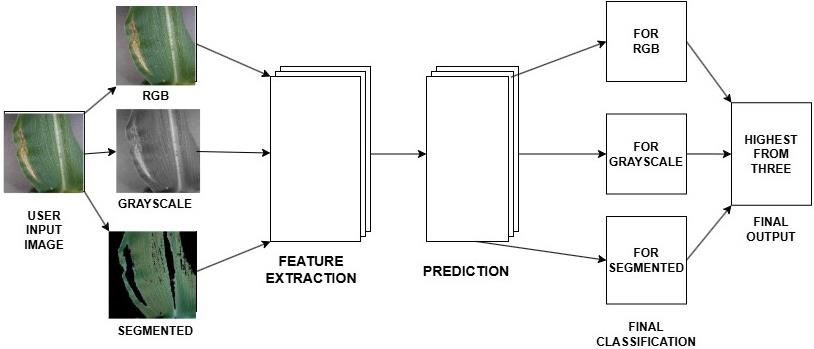
This study converts a single maize leaf image into three formats: 1) RGB, 2) grayscale, and 3) segmented. Data augmentation techniques like rotation and flipping were applied, and all images were resized to 244×244 pixels. Each image format is processed by a separate CNN, and the final disease class prediction is determined using a majority voting mechanism. The model achieved an accuracy of 94.3%, demonstrating the effectiveness of the multi-format approach for maize disease detection.
3. Figures and Tables
3.1 Dataset Preparation
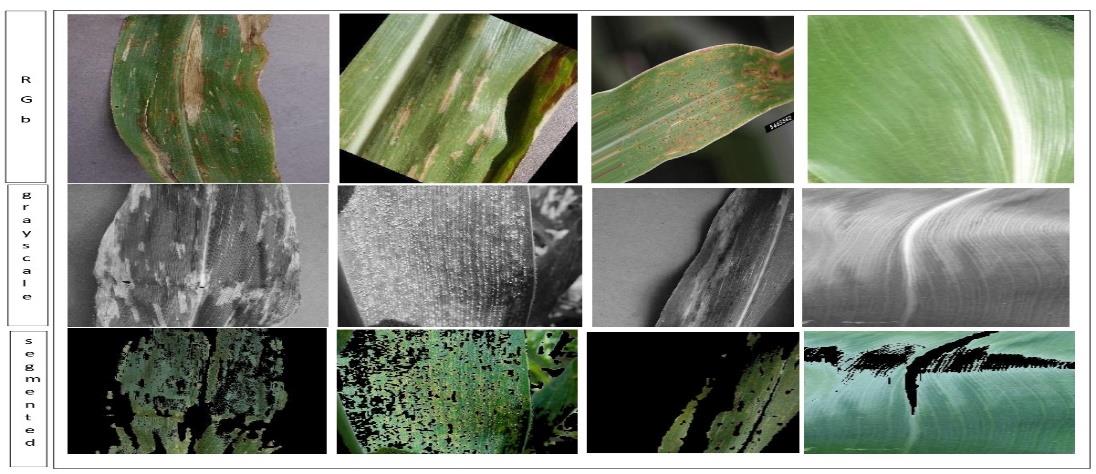
The dataset utilized for this study comprised 4,000 maize leaf images, categorized into four distinct classes: 1) Cercospora leaf spot (1,000 images), 2) Common rust (1,000 images), 3) Northern leaf blight (1,000 images), and 4) healthy leaves (1,000 images).
Data augmentation techniques such as rotation, flipping, and zooming were applied to enhance the model's ability to generalize, introducing variability into the training data. All images were resized to a uniform dimension of 244×244 pixels, ensuring compatibility with the CNN architecture. Segmented images were additionally generated by applying HSV color thresholding, effectively isolating regions of interest associated with diseased areas.
3.2 Ensemble Voting
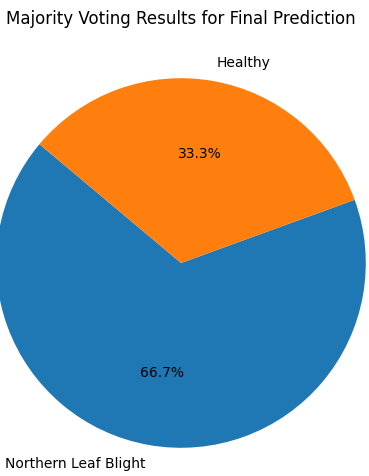
To enhance robustness, predictions from the three image formats (RGB, grayscale, and segmented) were combined using an ensemble majority voting approach. Each format was processed independently through the CNN, and the final output was determined based on the class agreed upon by at least two formats.
3.3 Evaluation Metrics
The model's performance was evaluated using accuracy (Overall correctness), precision (True positives among predicted positives), recall (Ability to identify actual positives), and F1-score (Harmonic mean of precision and recall).
Table 1. Performance metrics for different images.
This table is shown in the PDF version of the article.
4. Conclusion and Future Scope
This study uses deep learning to present a multi-format image analysis approach for maize disease detection. By combining RGB, grayscale, and segmented images, the model achieved an accuracy of 94.3%. CNNs and ensemble voting significantly improved the model's reliability, providing an effective and scalable solution for early disease detection. This can help reduce crop losses and enhance agricultural productivity.
Future work can focus on refining the model's accuracy by exploring advanced deep learning architectures and improving image preprocessing. The model can also be expanded to detect a wider range of diseases and applied to other crops. Integrating real-time monitoring systems and developing mobile apps could make the technology more accessible to farmers, promoting timely interventions and supporting sustainable agriculture.
Author Contributaion
Kuna Hasada
Conceptualized the research, designed the methodology, and wrote the manuscript draft
Antaryami Sing
Contributed to data collection, preprocessing, and augmentation
Basudev Mallick
Implemented the CNN models, performed the experiments, and analyzed the results
Dharamendra Sing
Provided technical insights on ensemble learning and image processing
Funding
No specific funding was received for this research.
Data Availability
The data supporting the findings of this study are available upon reasonable request from Kuna Hasada.
Conflicts of Interest
The authors declare no conflicts of interest in this work.
References
- [1] Erenstein, O., Jaleta, M., Sonder, K., Mottaleb, K., & Prasanna, B. M. (2022). Global maize production, consumption and trade: Trends and R&D implications. Food security, 14(5), 1295–1319. https://doi.org/10.1007/s12571-022-01288-7
- [2] Dhugga, K. S. (2007). Maize biomass yield and composition for biofuels. Crop science, 47(6), 2211–2227. https://doi.org/10.2135/cropsci2007.05.0299
- [3] Ostrander, B. (2015). Maize starch for industrial applications. In Industrial crops. handbook of plant breeding ( pp. 171–189). Springer, New York, NY. https://doi.org/10.1007/978-1-4939-1447-0_9
- [4] Martin, D. P., & Shepherd, D. N. (2009). The epidemiology, economic impact and control of maize streak disease. Food security, 1, 305–315. https://doi.org/10.1007/s12571-009-0023-1
- [5] Logrieco, A., Battilani, P., Leggieri, M. C., Jiang, Y., Haesaert, G., Lanubile, A., … ., & Pasti, M. (2021). Perspectives on global mycotoxin issues and management from the MycoKey maize working group. Plant disease, 105(3), 525–537. https://doi.org/10.1094/PDIS-06-20-1322-FE
- [6] Mesterházy, Á., Lemmens, M., & Reid, L. M. (2012). Breeding for resistance to ear rots caused by Fusarium spp. in maize–a review. Plant breeding, 131(1), 1–19. https://doi.org/10.1111/j.1439-0523.2011.01936.x
- [7] Carvajal-Moreno, M. (2022). Mycotoxin challenges in maize production and possible control methods in the 21st century. Journal of cereal science, 103, 103293. https://doi.org/10.1016/j.jcs.2021.103293
- [8] Fatma, H. K., Tileye, F., & Patrick, A. N. (2016). Insights of maize lethal necrotic disease: A major constraint to maize production in East Africa. African journal of microbiology research, 10(9), 271–279. https://doi.org/10.5897/AJMR2015.7534
- [9] Ekwomadu, T. I., & Mwanza, M. (2023). Fusarium fungi pathogens, identification, adverse effects, disease management, and global food security: A review of the latest research. Agriculture, 13(9), 1810. https://doi.org/10.3390/agriculture13091810
- [10] Singh, V. K., Singh, R., Kumar, A., & Bhadouria, R. (2021). Current status of plant diseases and food security. In Food security and plant disease management (pp. 19–35). Elsevier. https://doi.org/10.1016/B978-0-12-821843-3.00019-2
- [11] Kalunga, P., & Kunda, D. (2024). Investigation of the suitability of existing maize plant leaf disease detection and classification approaches: Challenges and open issues. Zambia information and communication technology journal, 8(1), 70–79. https://doi.org/10.33260/zictjournal.v8i1.343
- [12] Attri, I., Awasthi, L. K., Sharma, T. P., & Rathee, P. (2023). A review of deep learning techniques used in agriculture. Ecological informatics, 77, 102217. https://doi.org/10.1016/j.ecoinf.2023.102217
- [13] Bhise, D., Kumar, S., & Mohapatra, H. (2022). Review on deep learning-based plant disease detection. 2022 6th international conference on electronics, communication and aerospace technology (pp. 1106–1111). IEEE. https://doi.org/10.1109/ICECA55336.2022.10009290
- [14] Mishra, S. R., Mohapatra, H., & Saxena, S. (2024). Leveraging data analytics and a deep learning framework for advancements in image super-resolution techniques: From classic interpolation to cutting-edge approaches. In Data analytics and machine learning: Navigating the big data landscape (pp. 105–126). Singapore: Springer Nature Singapore. https://doi.org/10.1007/978-981-97-0448-4_6