
Energy-Effcient Smart Cities with Green Internet of Things
Abstract
The increasing number of Internet of Things (IoT) devices in smart cities has resulted in a significant rise in energy usage. To promote sustainability and minimize environmental effects, it is essential to investigate green energy options. This study examines the challenges related to IoT energy usage in smart cities and explores diverse green energy solutions. It evaluates the benefits and drawbacks of solar, wind, and geothermal energy, along with energy-efficient designs for IoT devices and centralized energy management systems. Furthermore, the paper underscores the significance of policy frameworks and collaborations between public and private sectors in encouraging the uptake of green energy solutions.
Keywords:Internet of thingsLoad balancingScheduling algorithms
1. Introduction
Smart cities, characterized by their integration of technology and urban infrastructure, are rapidly expanding worldwide. Internet of Things (IoT) devices enable smart city functionalities like transportation, healthcare, and environmental monitoring. However, the increasing deployment of IoT devices has raised concerns about energy consumption and environmental impact [1]–[3]. To address these challenges, sustainable and green energy solutions are imperative.
Green energy technologies for internet of things smart cities renewable energy sources I. Solar power: Solar panels can be integrated into various urban infrastructures, including rooftops, streetlights, and public transportation systems [4].
II. Wind power: Wind turbines can be installed in suitable locations, such as coastal areas or elevated structures. III. Hydropower: Harnessing the energy of flowing water through dams, turbines, or micro-hydro systems. IV. Geothermal energy: Utilizing the heat from the Earth's interior to generate electricity or heat [5].
Energy-efficient internet of things devices
I. Low-power wireless technologies: Adopting technologies like LoRaWAN, Sigfox, and Narrowband IoT (NB-IoT) for reduced energy consumption II. Energy harvesting: Utilizing ambient energy sources, such as vibration, light, or temperature, to power IoT devices III. Intelligent power management: Implementing algorithms and strategies to optimize power consumption and battery life
Energy management strategies
I. demand response: Encouraging flexible energy consumption patterns to align with renewable energy generation II. Energy storage: Using batteries, flywheels, or other storage systems to store excess energy for later use III. Microgrids: Creating localized power grids that operate independently or in conjunction with the primary grid
2. Green Internet of Things
Almost all the sectors have been modifed and updated due to the massive transformation and advancement in Information Technology (IT), with an increasing trend toward the IoT [6], [7]. Through IoT integration and the connection of various gadgets to the internet, no human intervention is possible. The smarter the world is becoming with all the smart technologies to modify the quality of life, the more burden there is on the environment due to the increased carbon footprint. The answer to this problem is only Green IoT (G-IoT). G-IoT will aid in reducing emissions and pollution, which exploits environmental maintenance and surveillance, and will also minimize the cost of operation and power consumption. In other words, it is a form of power optimization that can help reduce the greenhouse effect [8].
Various domains are focused on G-IoT, starting from manufacturing to consumption as well as planning and, in subsequent stages, recycling and disposal, which impact the environment. Green society can be enabled with G-IoT concerning energy utilization with different domains like smart ecosystems, smart cities, mobile e-health, and smart networks. Discussing further, G-IoT combines innovative resources to minimize the negative influence of IoT on the ecosystem. The main aim of G-IoT is to reduce carbon dioxide and pollution emissions to preserve the environment and optimize the cost of operation and power consumption. For a safer environment, IoT's reduction of energy consumption is mandatory [9]. In the upcoming rapid development of green information communication technologies, IoT is showing promising potential to boost the growth of the economy and the sustainability of the environment. This upcoming technology will make the world smart and environment-friendly.
The six key components of a smart city are smart transportation, smart lifestyle, smart economy, smart ecosystem, smart citizens, and smart governance. Most sectors of urban expansion, such as government functions, city procedures, delivery of services, and intelligent analytics, improve the services, production, and usability by embedding Information and Communication Technologies (ICTs) and IoT [10]. The aim of smart cities is focused on the reduction of carbon footprint, improvement in energy effciency, superior quality of living ecosystem, more green areas, advanced infrastructure, and evolution of the city. The transition to smart cities is complicated and in an omni-dimensional phase. Collective integration of technical, policy, structural, and transitional components relies on city transformation. Smart cities with business prospects will provide technology and information-based services for economic growth [11].
3. Smart City
The smart city concept was coined in 1994, and since then, the concept has been the topic of discussion. Although the concept is quite discussed, there is no clear understanding of smart cities. As per common insight, smart cities are innovative urbanization and smart concepts to tackle urban problems, especially with the environment, houses, people, and their well-being [12]. Smart cities are also defned as places where services are provided with effciency by utilizing technology for beneftting the people or the environment. The expansion of smart cities improves citizens' lives, the environment's productivity, sustainability, and safety, and technology can be monitored and operated centrally [13].
The six key components of a smart city are: 1) smart transportation, 2) lifestyle, 3) economy, 4) ecosystem, 5) citizens, and 6) governance. Most sectors of urban expansion, such as government functions, city procedures, delivery of services, and intelligent analytics, improve the services, production, and usability by embedding ICTs and IoT. The aim of smart cities is focused on the reduction of carbon footprint, improvement in energy effciency, superior quality of living ecosystem, more green areas, advanced infrastructure, and evolution of the city [14].
The transition to smart cities is complicated and in an omni-dimensional phase. The collective integration of technical, policy, structural, and transitional components relies on city transformation. Smart cities with business prospects will provide technology and information-based services for economic growth [15].
4. Smart Cities with Green Internet of Things for Sustainable Environment
Urban growth and city population are rising exponentially, creating numerous environmental, social, and societal sustainability problems for cities. Congestion of traffc, weak infrastructure, health problems, resource scarcity, instructive diffculties, poor infrastructure, rising rates of crime, fewer jobs, old structure, power larceny, supply link problems, inadequate capacity for power generation, an extraordinary loss of power in transmission, regular power interruptions, and absence of real-time information division are such problems [16]. Critical infrastructure and reserve supply restrictions generate problems for growing populations to provide nutritious food, electricity, and clean water. Besides cost-cutting, standard changes to online facilities, temperature change issues, economic rearrangement, and employment reduction, cities are under the burden of public finances to reduce finances. Thus, smarter ways are important for people to handle urban problems and face-lift city life, productive infrastructures, and value-added services [17].
Because of the lifestyle and quality of people's daily activities, a sustainable place must be built that takes care of all stakeholders, enterprises, and government. Individuals will also have to play a role in creating a sustainable living space and attempt to handle issues like weather change, natural resource exhaustion, and biodiversity decline. The main goal of the G-IoT revolution is to advance the quality of life and safeguard the world from these problems using technical advances [18].
G-IoT makes cities smarter by linking smart sensors, computers, cars, and infrastructure at all city locations. G-IoT helps stakeholders reduce chemical emissions and water usage and improve the protection of life and the health of human beings. G-IoT has two features for this smart city-making design:
I. Planning and developing G-IoT devices for improved networking setups and communication procedures and maximizing the bandwidth through minimal energy usage.
II. Installing these G-IoTs and advanced technologies minimizes emissions of dangerous gases and enhances living space.
5. Methodology
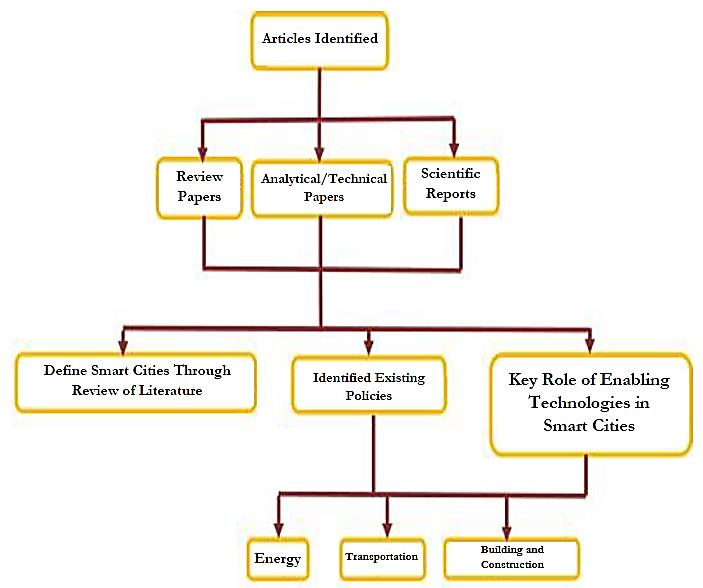
This conceptual paper focuses on the current knowledge of Smart cities’ readiness for G-IoT-enabled sustainable practices. The researcher will focus on identifying and exploring how different empowering technologies, like the internet, smart objects, sensors, etc., may be effectively utilized to attain G-IoT in smart cities [19]. This research article will also evaluate numerous IoT frameworks, initiatives, and standardization efforts currently under way and the potential issues to be tackled in the future to implement G-IoT for smart cities.
The following objectives should be fulflled by literature reviews: first, a review must consolidate all the fndings of the research by studying and fusing various pieces of literature of a particular research area to fnd the research gap and act as a catalyst for upcoming research. Secondly, large amounts of data can be gathered by reviewing appropriate literature, which will be reliable, precise, and can be retrofitted as per the requirement [20]. Whenever G-IoT and smart cities come into the picture, people and ease of use are embossed as emerging research thrust areas for the future.
The current research looks to answer the following:
I. The key concepts of G-IoT in smart cities.
II. What are the G-IoT sustainability practices for smart cities?
III. Readiness for G-IoT-driven sustainability in smart cities.
IV. The key concept of G-IoT and sustainability.
6. Green Internet of Things for Sustainable Traffic Control
G-IoT refers to integrating IoT technologies with sustainable practices to optimize resource utilization and minimize environmental impact.
In the context of traffic control, G-IoT solutions can be categorized into three primary areas:
Smart traffic lights
I. Adaptive Traffic Control Systems (ATCSs): Real-time monitoring of traffic conditions to adjust signal timings accordingly II. Vehicle-to-Infrastructure (V2I) communication: Enabling vehicles to communicate with traffic lights, providing real-time traffic information, and optimizing signal timings III. Green wave systems: Coordinating traffic signals to create a continuous green wave for vehicles traveling at a specific speed
Connected vehicles
I. Cooperative Adaptive Cruise Control (CACC): Maintaining a safe following distance between vehicles and reducing the need for frequent braking and acceleration II. Platooning: Grouping vehicles to improve fuel efficiency and reduce congestion III. Vehicle-to-Vehicle (V2V) communication: Enabling vehicles to exchange information about their location, speed, and intentions
Real-time traffic monitoring systems
I. Sensor networks: Deploy various sensors (e.g., cameras, loops, ultrasonic sensors) to collect data on traffic flow, speed, and congestion II. Data analytics: Using advanced analytics techniques to extract valuable insights from the collected data III. Traffic information dissemination: Providing real-time traffic updates to drivers through various channels (e.g., mobile apps, variable message signs) Future directions:
I. Integration with other urban systems: Combining G-IoT with smart grids, buildings, and public transportation systems for a more integrated and sustainable urban environment II. Autonomous vehicles: Exploring the role of G-IoT in supporting the deployment of autonomous vehicles and enhancing traffic efficiency III. Advanced analytics and machine learning: Leveraging AI techniques to improve traffic prediction, congestion management, and incident detection
7. Waste Internet of Things for Sustainable Management
The increasing generation of waste, coupled with inefficient management practices, has led to severe environmental and public health issues. Traditional waste management approaches often lack the efficiency and sustainability required to address these challenges. With their ability to connect physical objects to the internet, IoT technologies offer promising solutions for optimizing waste management processes and promoting a circular economy [21].
7.1 Waste Internet of Things Applications
Smart bins
I. Real-time monitoring of waste levels to optimize collection routes and reduce unnecessary trips II. Integration with payment systems for pay-as-you-throw schemes III. Integration with sensors to detect hazardous materials or recyclable items
Waste tracking systems
I. Tracking the movement of waste from generation to disposal to ensure proper handling and compliance with regulations II. Identifying leaks or unauthorized dumping III. Optimizing waste transportation routes
Internet of things-enabled recycling facilities
I. Automated sorting and separation of recyclable materials
II. Real-time monitoring of facility operations and performance
III. Integration with waste tracking systems to ensure accurate recycling data
Waste-to-energy systems
I. Optimizing energy generation from waste through IoT-enabled monitoring and control II. Ensuring efficient and safe operation of waste-to-energy plants Challenges and opportunities:
I. Data privacy and security: Protecting sensitive data collected from IoT devices II. Infrastructure costs: Investing in the necessary infrastructure (e.g., sensors, communication networks) for Waste IoT deployment III. Interoperability: Developing standards and protocols for seamless communication between IoT devices and systems IV. Public acceptance: Addressing privacy, security, and the potential for job displacement Future directions:
I. Integration with other urban systems: Waste IoT can be combined with smart grids, smart cities, and public transportation systems for a more integrated and sustainable urban environment II. Advanced analytics and machine learning: Leveraging AI techniques to improve waste prediction, management, and recycling efficiency III. Circular economy: Promoting a circular economy by maximizing resource recovery and minimizing waste generation
8. Challenges and Opportunities in Smart Cities
Smart cities, characterized by their integration of technology and urban infrastructure, offer the potential to improve quality of life, enhance sustainability, and promote economic growth. However, the transition to a smart city is not without its challenges. This paper explores the key challenges and opportunities associated with smart city development, comprehensively understanding the complexities involved.
8.1 Challenges
Data privacy and security
I. Protecting sensitive data collected from IoT devices and sensors II. Preventing unauthorized access and data breaches III. Ensuring compliance with data protection regulations
Digital divide
I. Addressing the gap in access to technology and digital skills among different socioeconomic groups II. Ensuring smart city initiatives benefit all residents, not just the privileged few
Infrastructure costs
I. Investing in the necessary infrastructure (e.g., sensors, communication networks, smart grids) for smart city development II. Balancing the initial costs with long-term benefits
Interoperability
I. Ensuring compatibility between different IoT devices and systems from various vendors II. Developing standards and protocols for seamless data exchange
Public acceptance
I. Addressing concerns related to privacy, security, and job displacement II. Building trust and transparency in smart city initiatives
Sustainability
I. Ensuring that smart city solutions are environmentally sustainable and reduce carbon emissions II. Balancing economic growth with environmental protection
Governance and policy
I. Developing effective governance structures and policies to support smart city development II. Addressing regulatory challenges and ensuring accountability
8.2 Opportunities
Improved quality of life
I. Enhancing public safety and security through advanced surveillance systems II. Improving transportation efficiency and reducing congestion III. Enhancing energy efficiency and reducing carbon emissions IV. Improving healthcare services and access to information
Economic growth
I. Attracting businesses and investments to smart cities II. Creating new jobs and economic opportunities III. Fostering innovation and entrepreneurship
Enhanced sustainability
I. Promoting sustainable practices in transportation, energy, and waste management II. Reducing environmental impact and improving air quality
Improved governance
I. Using data and analytics to make informed decisions and improve public services II. Increasing transparency and accountability in government
Social inclusion
I. Bridging the digital divide and ensuring all residents benefit from smart city initiatives II. Promoting social equity and inclusion
9. Conclusion
Integrating IoT devices in smart cities has significantly increased energy consumption. Green energy solutions are becoming increasingly essential to address this challenge and promote sustainability. By leveraging renewable energy sources, energy-efficient IoT devices, and effective energy management strategies, cities can reduce their carbon footprint and create a more sustainable future.
Key takeaways
I. Renewable energy sources: Solar, wind, hydro, and geothermal power can provide clean and sustainable energy for IoT devices and infrastructure II. Energy-efficient IoT devices: Adopting low-power technologies, energy harvesting, and intelligent power management can reduce the energy consumption of IoT devices III. Energy management strategies: Demand response, energy storage, and microgrids can optimize energy use and integrate renewable energy sources into the grid IV. Government policies and public-private partnerships: Supportive policies and collaboration between governments, businesses, and research institutions are crucial for driving the adoption of green energy solutions
Future directions
I. Advancements in renewable energy technologies: Continued research and development in solar, wind, and other renewable energy sources to improve efficiency and reduce costs II. IoT device innovations: Development of even more energy-efficient IoT devices and sensors III. Integration of green energy solutions: Seamless integration of renewable energy sources and energy management strategies into existing smart city infrastructure IV. Public awareness and education: Raising awareness about the importance of green energy solutions and promoting sustainable practices
Funding
No specific funding was received for this research.
References
- [1] Pratap, A., Nayan, H., Panda, P., & Mohapatra, H. (2024). Emerging technologies and trends in the future of smart cities and IoT: A review. Journal of network security computer networks, 10(2), 28–38. https://matjournals.net/engineering/index.php/JONSCN/article/view/606
- [2] Mohapatra, H., Rath, A. K., & Panda, N. (2022). IoT infrastructure for the accident avoidance: An approach of smart transportation. International journal of information technology, 14(2), 761–768. https://doi.org/10.1007/s41870-022-00872-6
- [3] Gadre, M., & Gadre, Ch. (2016). Green internet of things (IoT): Go green with IoT. International journal of engineering research & technology (IJERT), 4(Spec. Issue), 1-29. https://B2n.ir/g67515
- [4] Al-Turjman, F., Kamal, A., Husain Rehmani, M., Radwan, A., & Khan Pathan, A. S. (2019). The green internet of things (G-IoT). Wireless communications and mobile computing, 2019(1), 6059343. https://doi.org/10.1155/2019/6059343
- [5] Rahman, S. (2003). Green power: What is it and where can we find it? IEEE power and energy magazine, 1(1), 30–37. https://doi.org/10.1109/MPAE.2003.1180358
- [6] Arshad, R., Zahoor, S., Shah, M. A., Wahid, A., & Yu, H. (2017). Green IoT: An investigation on energy saving practices for 2020 and beyond. IEEE access, 5, 15667–15681. https://doi.org/10.1109/ACCESS.2017.2686092
- [7] King, S., & Cotterill, S. (2007). Transformational government? the role of information technology in delivering citizen-centric local public services. Local government studies, 33(3), 333–354. https://doi.org/10.1007/978-3-319-03167-5_4
- [8] Shah, K., & Narmawala, Z. (2018). A survey on green internet of things 2018 fourteenth international conference on information processing (ICINPRO) (pp. 1-4). IEEE. http://dx.doi.org/10.1109/ICINPRO43533.2018.9096789
- [9] Gapchup, A., Wani, A., Wadghule, A., & Jadhav, S. (2017). Emerging trends of green IoT for smart world. International journal of innovative research in computer and communication engineering, 5(2), 2139–2148.
- [10] Huang, J., Meng, Y., Gong, X., Liu, Y., & Duan, Q. (2014). A novel deployment scheme for green internet of things. IEEE internet of things journal, 1(2), 196–205. https://doi.org/10.1109/JIOT.2014.2301819
- [11] Rani, S., Talwar, R., Malhotra, J., Ahmed, S. H., Sarkar, M., & Song, H. (2015). A novel scheme for an energy efficient internet of things based on wireless sensor networks. Sensors, 15(11), 28603–28626. https://doi.org/10.3390/s151128603
- [12] Dameri, R. P., & Cocchia, A. (2013). Smart city and digital city: Twenty years of terminology evolution. X conference of the Italian chapter of AIS, ITAIS (pp. 1–8). Urban development. https://B2n.ir/t60091
- [13] Jucevičius, R., Patašienė, I., & Patašius, M. (2014). Digital dimension of smart city: critical analysis. Procedia - social and behavioral sciences, 156, 146–150. https://doi.org/10.1016/j.sbspro.2014.11.137
- [14] Angelidou, M. (2015). Smart cities: A conjuncture of four forces. Cities, 47, 95–106. https://doi.org/10.1016/j.cities.2015.05.004
- [15] Zhu, C., Leung, V. C. M., Shu, L., & Ngai, E. C. H. (2015). Green internet of things for smart world. IEEE access, 3, 2151–2162. https://doi.org/10.1109/ACCESS.2015.2497312
- [16] Neirotti, P., De Marco, A., Cagliano, A. C., Mangano, G., & Scorrano, F. (2014). Current trends in smart city initiatives: some stylised facts. Cities, 38, 25–36. https://doi.org/10.1016/j.cities.2013.12.010
- [17] Bulu, M. (2014). Upgrading a city via technology. Technological forecasting and social change, 89, 63–67. https://doi.org/10.1016/j.techfore.2013.12.009
- [18] Niaros, V., Kostakis, V., & Drechsler, W. (2017). Making (In) the smart city: The emergence of makerspaces. Telematics and informatics, 34(7), 1143–1152. https://doi.org/10.1016/j.tele.2017.05.004
- [19] Elmaghraby, A. S., & Losavio, M. M. (2014). Cyber security challenges in smart cities: Safety, security and privacy. Journal of advanced research, 5(4), 491–497. https://doi.org/10.1016/j.jare.2014.02.006
- [20] Ojo, A., Curry, E., Janowski, T., & Dzhusupova, Z. (2015). Designing next generation smart city initiatives: The SCID framework. In transforming city governments for successful smart cities (pp. 43–67). Cham: Springer International Publishing. https://doi.org/10.1007/978-3-319-03167-5_4
- [21] Bibri, S. E., & Krogstie, J. (2017). Smart sustainable cities of the future: An extensive interdisciplinary literature review. Sustainable cities and society, 31, 183–212. https://doi.org/10.1016/j.scs.2017.02.016