
AI-Enhanced IoT for Real-Time Urban Waste Management
Abstract
The document discusses the automation of waste management systems aimed at promoting cleanliness and hygiene. The act of littering in streets and public spaces is a prevalent issue in many developing nations, leading to environmental harm and several unhygienic conditions. To tackle these challenges, the concept of Smart Netbin has been introduced, which integrates hardware and software technologies by linking a standard dustbin to a Wi-Fi system to offer users complimentary internet access for a limited time. This technology incentivizes individuals to maintain a clean environment, thereby complementing effective waste management in the community. Smart Netbin employs various technologies: 1) it measures the volume of waste disposed, 2) it tracks the movement of the waste, and 3) it transmits necessary signals and connects users to the Wi-Fi network. The proposed system will operate on a client-server model, ensuring a cleaner environment, better health, and a pollution-free community.
Keywords:Load CellInternet of thingsLoad sensing plateArduinoWi-FiInternet
1. Introduction
The amount of waste produced daily by industries and households is increasing alarmingly. The growing consumption of packaged items, textiles, paper, food, plastics, metals, glass, and more is a significant contributor to this rise. Effective waste management has thus become essential in our daily lives. While many developed countries have efficient waste management systems, numerous developing nations face challenges [1]. Issues like public indifference to clean surroundings, a lack of strict laws promoting biodegradable materials, inadequate environmental policies, and limited focus on sustainable development are significant obstacles, often leading to poor waste management practices with serious consequences [2].
The growing volume of waste often results in overflowing public bins, littered streets, and unsanitary conditions that harm health and the environment. Managing waste has become a critical issue requiring smart solutions. Many households attempt to segregate waste to facilitate processing and recycling, but irregular trash collection disrupts this system. As a result, people often resort to dumping trash in open spaces, worsening environmental pollution. Waste becomes a health hazard, serving as a breeding ground for bacteria, insects, flies, and other pests [3]. These pests spread diseases like food poisoning, typhoid, gastroenteritis, malaria, and dengue. Additionally, stray animals attracted by garbage can transmit various illnesses while releasing toxic gases like CO2, methane, and nitrous oxide, contributing to air and water pollution and further harming human health and the environment [4].
Overflowing garbage also negatively impacts public spaces, making them unsightly and deterring tourists. Clean cities are attractive and promote economic growth, while unclean, malodorous cities lose tourism revenue and related opportunities [5]. In India alone, over 62 million tons of garbage are generated annually by 377 million urban residents, making it the world's third-largest waste generator. However, the primary issue isn't the quantity of waste but rather that over 45 million tons of it remain untreated and are disposed of unsafely by municipal authorities each day.
Addressing this problem requires a multifaceted approach. Governments should implement stricter laws to prevent littering, promote biodegradable materials, encourage recycling, reduce non-degradable waste, and support the reuse of materials. Technology is also crucial to improving waste disposal and minimizing its environmental impact.
Today, the internet is a part of everyday life, with most people relying on connectivity through smartphones, tablets, or laptops [6]. However, high data costs or connectivity issues can sometimes restrict internet access. To leverage this need, a system providing free Wi-Fi as a reward for disposing of waste properly could incentivize cleanliness in public areas. Combining waste management with internet access can encourage individuals to maintain clean surroundings while satisfying their connectivity needs. This approach offers a practical solution to the waste problem and promotes a cleaner, healthier environment.
2. Literature Survey
The concept of an Internet of Things (IoT) based dustbin is not original and has been implemented in various forms [7]. Some authors have designed systems where sensors inside the bin detect whether it is complete. When the bin reaches capacity, an automated message is sent to the system's server via an Arduino SIM module. Upon receiving the message, the server forwards it to the designated worker. If the worker is available, they confirm by accepting the task and proceed to the location; if not, the task is reassigned to another worker.
Other implementations include real-time waste management systems using smart bins that monitor fill levels [8]. In these systems, authorized personnel can access information about each smart bin remotely and make informed decisions based on the bin's status. This approach has been shown to reduce costs, optimize resources, and make smart bins more efficient. It ultimately reduces city traffic by enabling collection vehicles to visit areas only when bins are full.
Some systems employ an Infrared (IR) sensor, microcontroller, and Wi-Fi module to ensure timely waste collection. When a dustbin reaches its maximum capacity, the system notifies the responsible authority [9]. If the bin is not emptied within a specific time frame, reports are escalated to higher authorities for necessary action against the contractor in charge. This setup promotes cleanliness and minimizes the chance of false reports, reducing corruption within the waste management system.
An innovative approach introduced dustbins with Wi-Fi routers and Passive Infrared (PIR) sensors [10]. In this system, when a user disposes trash, the PIR sensor detects the waste and sends a signal to a microcontroller. The microcontroller then communicates with the Wi-Fi router, which generates a temporary access code. The code is displayed on an LCD screen, and users can enter it on a PHP interface hosted on a server. Upon validation, the server provides the user with the main Wi-Fi password, allowing them internet access for 10 minutes, after which the connection automatically terminates.
3. Flaws in the Existing System
The main problems of the existing solid waste collection process and management system are as follows [11], [12]:
I. More complications in the processing II. Many controlling units linked with each other III. Higher implementation cost
4. Proposed System
The Smart Netbin is an enhanced dustbin, upgraded using a microcontroller-based platform with an Arduino Uno board, interfaced with a load sensor and a Wi-Fi module. The system comprises two main modules: 1) mechanical, and 2) electronic.
The mechanical components include a shredder and a load-sensing plate. The electronic components include various devices, including an Arduino Uno, Load Cell, LCD, IR sensor, amplifier, relay module, and Wi-Fi router.
When a user disposes of trash, it is first shredded within the dustbin and then collected on the load-sensing plate. The load sensor attached to this plate measures the weight of the trash. Once the weight reaches a predefined limit, the Wi-Fi router's password is displayed on the LCD screen, although the router remains off. To complete the process, the user must pull the load-sensing plate to allow the shredded trash to fall into the main dustbin. The IR sensor detects This falling motion, which triggers further system actions.
Advantages of the proposed system over existing models:
I. Low implementation cost II. Simple module III. Easy functionality
5. System Architecture
5.1 The Dustbin
A normal dustbin made of plastic or metal that can hold up all the installed components. The mechanical shredder will be installed on the top side, and the load sensing plate at the mediocre level of all the IoT components will be installed on the bottom. Thus, it should be of average size (Height_600-700mm dia_).
5.2 Sensors
The sensing unit will mainly consist of two sensors: 1) the load sensor, and 2) the IR sensor. The load sensor measures the weight of trash being dumped into the dustbin and is attached to the bottom side of the load sensing plate; the IR sensor detects the downward motion of trash once the load sensing plate is pulled out and the trash falls in the bin [13], [14].
5.3 Load Cel
During a measurement, the weight acts on the Load Cell's metal spring element and causes elastic deformation. This strain (Positive or negative) is converted into an electrical signal by a Strain Gauge (SG) installed on the spring element.
Product name: Load Cell Load: 10Kg /22lb Rated output: 1+/-0.15mV/V Recommend excitation voltage: DC 5V; max excitation Voltage: DC 10V
5.4 Infrared Sensor
An IR sensor is an electronic instrument that senses specific characteristics of its surroundings. It does this by either emitting or detecting IR radiation. IR sensors are also capable of measuring the heat being emitted by an object and detecting motion.
Operating voltage range - 3.6~5 VDC Average current consumption (mA) 0.06 Detection Angle - 35 ° Distance measuring range - 2 ~ 30cm
5.5 Wi-Fi Module
It consists of a router, which provides the user with internet access while dumping the trash into the bin.
5.6 Microcontroller
Arduino will be the processing unit for the embedded system in the bins. It will control sensors and send information.
5.7 HX711 Amplifier
Differential input voltage: ±40mV (Full-scale differential input voltage is ± 40mV) Operating voltage: 2.7V to 5VDC Operating current: <10 mA
5.8 LCD Display
The operating Voltage is 4.7V to 5.3V.
Current consumption is 1mA without backlight.
LCD Display (16*2).
5.9 Power Supply
The power supply will provide electrical power for the microcontroller, the shredder, and the router, which are the system's most important parts.
5.10 Shredder
A mechanical horizontal two-shaft shredder is a machine that reduces the size of all kinds of material. It consists of a shredding blade, loading box, box bracket, power system, the blade used is made of steel. The specifications:
Voltage 200-300V Power 4-15 kw Capacity 80-800
5.11 Load Sensing Plate
The load sensing plate is specifically designed to fit the dustbin dimensions. It can be made of plastic, wood, or metal. It is used to collect the waste dumped into the bin, and as the load sensor is attached to its bottom, it measures the weight of the trash dumped in. It consists of holes so that the sand soil mud flows down through these holes, and their weight is not considered. also, the holes reduce the overall weight of the plate.it is installed at the 1/4th height from the top of the dustbin.
I. Smart cities II. Technology development III. Tourist attraction Once implemented, this method would be easy to work on. The garbage will be dumped into the bins, thereby reducing the health threats imposed by the trash present all around.
6. Methodology
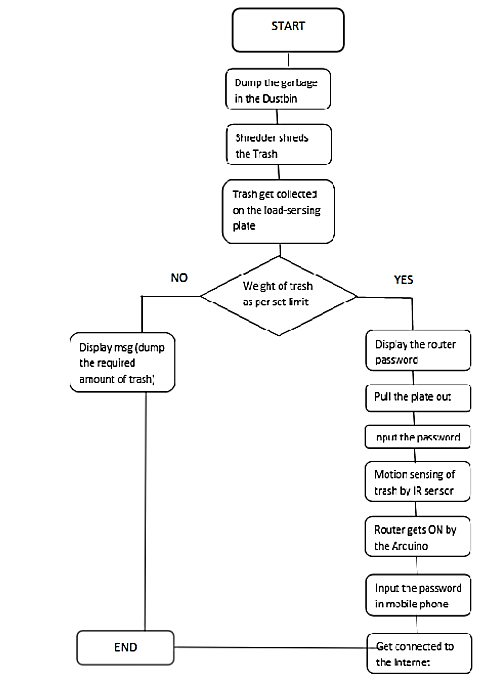
7. Advantages
The proposed plan has many advantages. It is also cogent enough to be implemented in every street of a developing nation. The advantages lie in its easy and valuable functioning.
This will improve the streets we live in and provide a pavement for a better working system.
I. Efficient and effective functioning II. Cleaner environs III. Better health issues IV. Pollution-free and stinking-free environs V. Smart cities VI. Technology development VII. Tourist attraction Once implemented, this method would be easy to work on. The garbage will be dumped into the bins, thereby reducing the health threats imposed by the trash present all around.
8. Future Works
The moisture sensor can be implemented in conjunction with the other sensors, and compartments for segregating dry and wet waste can be created, which will solve the issues related to waste segregation [15].
9. Conclusion
Improper disposal and improper maintenance of domestic waste creates issues in public health and the environment pollution; thus, this paper attempts to provide a practical solution towards managing the waste, collaborating it with the use of IoT, i.e., providing free internet facilities for a specific time once the trash is dumped into the bin. the proposed system will help to overcome all the serious issues related to waste and keep the environment clean.
Funding
This research did not receive any specific grant from funding agencies in the public, commercial, or not-for-profit sectors.
References
- [1] Wilson, D. C., Velis, C. A., & Rodic, L. (2013). Integrated sustainable waste management in developing countries. Proceedings of the institution of civil engineers-waste and resource management (pp. 52–68). Institution of civil engineers publishing. https://www.icevirtuallibrary.com/author/Wilson%2C+David+C
- [2] Rao, P. V., Azeez, P. M. A., Peri, S. S., Kumar, V., Devi, R. S., Rengarajan, A., ... ., & Praveenkumar, P. (2020). IoT based waste management for smart cities. 2020 international conference on computer communication and informatics (ICCCI) (pp. 1-5). IEEE. https://doi.org/10.1109/ICCCI48352.2020.9104069
- [3] Misra, V., & Pandey, S. D. (2005). Hazardous waste, impact on health and environment for development of better waste management strategies in future in India. Environment international, 31(3), 417–431. https://doi.org/10.1016/j.envint.2004.08.005
- [4] Muruka, C., & Muruka, A. (2007). Guidelines for environmental health management in children’s homes in Sub-Sahara Africa. International journal of environmental research and public health, 4(4), 319–331. https://doi.org/10.3390/ijerph200704040008
- [5] Kaur, M., Singh, A., & Kaur, A. (2024). Challenges and consequences of improper waste disposal in rural tourism. In Solid waste management and disposal practices in rural tourism (pp. 317–352). IGI Global. https://doi.org/10.4018/979-8-3693-9621-6.ch013
- [6] Vermesan, O., & Friess, P. (2013). Internet of things: Converging technologies for smart environments and integrated ecosystems. River publishers. https://books.google.com/books?hl=en&lr=lang_en&id=rHYGZ0wxLP0C&oi=fnd&pg=PR1&dq=
- [7] Suresh, P., Daniel, J. V., Parthasarathy, V., & Aswathy, R. H. (2014). A state of the art review on the internet of things (IoT) history, technology and fields of deployment. 2014 international conference on science engineering and management research (ICSEMR) (pp. 1–8). IEEE. https://doi.org/10.1109/ICSEMR.2014.7043637
- [8] Al Mamun, M. A., Hannan, M. A., Hussain, A., & Basri, H. (2016). Theoretical model and implementation of a real time intelligent bin status monitoring system using rule based decision algorithms. Expert systems with applications, 48, 76–88. https://doi.org/10.1016/j.eswa.2015.11.025
- [9] Misra, D., Das, G., Chakrabortty, T., & Das, D. (2018). An IoT-based waste management system monitored by cloud. Journal of material cycles and waste management, 20(3), 1574–1582. https://doi.org/10.1007/s10163-018-0720-y
- [10] Gawali, P., Shinde, S., Tambolkar, J., Shinde, G., & Sawant, S. (2023). Smart IoT based dustbin and waste monitoring system. 2023 international conference on advances in computation, communication and information technology (ICAICCIT) (pp. 1088-1093). IEEE. https://doi.org/10.1109/ICAICCIT60255.2023.10466052
- [11] Arebey, M., Hannan, M. A., Basri, H., & Abdullah, H. (2009). Solid waste monitoring and management using RFID, GIS and GSM. 2009 IEEE student conference on research and development (SCORED) (pp. 37–40). IEEE. https://doi.org/10.1109/SCORED.2009.5443382
- [12] Hannan, M. A., Arebey, M., Begum, R. A., & Basri, H. (2011). Radio frequency identification (RFID) and communication technologies for solid waste bin and truck monitoring system. Waste management, 31(12), 2406–2413. https://doi.org/10.1016/j.wasman.2011.07.022
- [13] Longhi, S., Marzioni, D., Alidori, E., Di Buo, G., Prist, M., Grisostomi, M., & Pirro, M. (2012). Solid waste management architecture using wireless sensor network technology. 2012 5th international conference on new technologies, mobility and security (NTMS) (pp. 1–5). IEEE. https://doi.org/10.1109/NTMS.2012.6208764
- [14] Reshmi, W., Sundaram, R. K., & Kumar, M. R. (2014). Sensor unit for waste management: A better method for frequent data updating system. 2014 international conference on science engineering and management research (ICSEMR) (pp. 1–5). IEEE. https://doi.org/10.1109/ICSEMR.2014.7043550
- [15] Singh, T., & Mohapatra, T. (2024). Sensor revolution: Unveiling the transformative impact on society. In Role of emerging technologies in social science (pp. 156). Cambridge Scholars Publishing. https://books.google.com/books?hl=en&lr=&id=f6MhEQAAQBAJ&oi=fnd&pg=PA156&dq=+