
Applications of Deep Learning to Cryptocurrency Trading: A Systematic Analysis
Abstract
This systematic review analyzes 75 papers (2020-2025) applying Deep Learning (DL) techniques to cryptocurrency trading. It evaluates various DL architectures, including Long Short-Term Memory (LSTM), Gated Recurrent Unit (GRU), Convolutional Neural Network (CNN), and Transformers, and finds that DL methods outperform traditional approaches in managing the high volatility and non-linear patterns of crypto markets. Key findings highlight the promise of hybrid and ensemble models, the benefits of integrating blockchain data, sentiment analysis, and macroeconomic factors for improved predictions, and the potential of Deep Reinforcement Learning (DRL) for developing autonomous trading strategies with risk-adjusted returns. However, challenges such as model interpretability, nonstationary data, and real-world deployment persist. The review emphasizes emerging directions like explainable Artificial Intelligence (AI) for transparent decision-making and high-frequency trading applications, providing a critical synthesis of methodologies, empirical results, and research gaps to inform both academic research and practical trading system development.
Keywords:CryptocurrencyDeep learningArtificial intelligenceCryptocurrency tradingReinforcement learningTime series analysis
1. Introduction
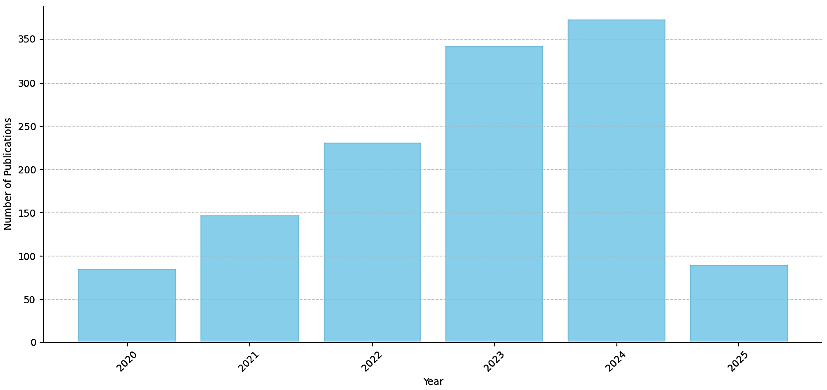
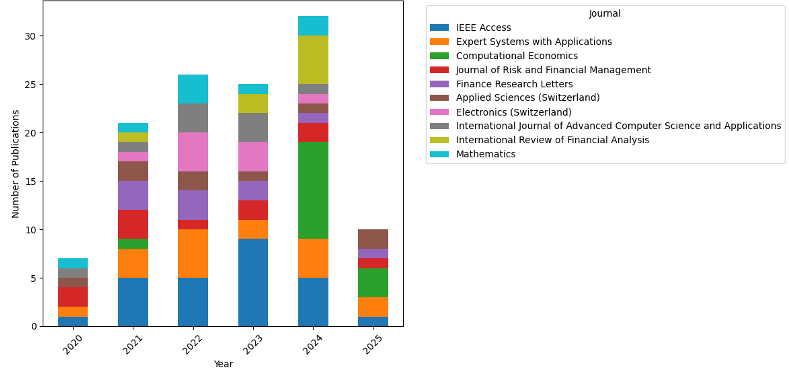
Cryptocurrencies have emerged as a major asset class, but their decentralized nature, volatility, and sensitivity to technological, regulatory, and macroeconomic factors make forecasting particularly challenging [1]. Traditional econometric and statistical models struggle to capture the non-linear and dynamic patterns of crypto markets [2], leading researchers to adopt Machine Learning (ML) and, more recently, Deep Learning (DL) methods [3]. Early approaches applied Support Vector Machines (SVMs) or Random Forests alongside Autoregressive Integrated Moving Average (ARIMA) or Generalized Autoregressive Conditional Heteroskedasticity (GARCH) [2], while current research emphasizes sequential models such as Long Short-Term Memory (LSTM), Gated Recurrent Unit (GRU), and Bi-LSTM [4], [5], as well as hybrid Convolutional Neural Network (CNN)-LSTM [6], attention mechanisms [7], and ensemble methods [6] to enhance prediction. Despite these advances, DL models often yield only incremental improvements and face persistent issues of overfitting, non-stationarity, and near-random walk behaviors [8], underscoring the need for careful model design and realistic expectations. This systematic review of 75 studies (2020–2025) addresses five research questions: 1) how effectively can various DL architectures forecast cryptocurrency prices compared to traditional methods? 2) what is the impact of integrating diverse data sources on model accuracy? 3) how can DL and Reinforcement Learning (RL) frameworks optimize automated trading strategies? 4) what are the challenges and limitations of applying DL to crypto markets? and 5) how can explainable Artificial Intelligence (AI) enhance interpretability in DL-driven trading models? AI, particularly DL and RL, is transforming cryptocurrency trading by addressing the unique challenges of high volatility, 24.7 trading, market inefficiencies, and sensitivity to external factors such as regulation and sentiment [9]. DL has become central to financial prediction due to its ability to automatically extract features from noisy, high-dimensional data and capture non-linear dependencies that traditional statistical models cannot [10]. Architectures like CNNs, LSTMs, GRUs, and Transformers have been widely applied for forecasting, while GANs support data augmentation in limited historical crypto datasets [9]. RL, grounded in Markov Decision Processes, enables agents to learn trading strategies through interaction with dynamic markets, with Deep Reinforcement Learning (DRL) (e.g., DQN, A2C, PPO, SAC) offering adaptive, automated trading strategies that account for costs and volatility [11]. As research rapidly grows, systematic reviews are essential for synthesizing findings, ensuring methodological rigor, and identifying future directions for robust, interpretable, and profitable applications of DL and RL in cryptocurrency trading [12]. Fig. 1 shows a steady increase in the number of publications from 2020 to 2024, peaking in 2024. Fig. 2 illustrates the distribution of publications across various journals from 2020 to 2025, showing varying contributions from each journal.
2. Methodology
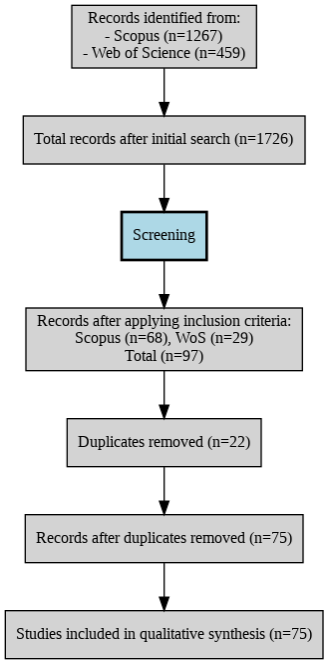
This review followed a systematic review to ensure methodological rigor and reduce bias in examining DL applications to cryptocurrency trading between 2020 and 2025. Using Scopus and Web of Science databases, an initial pool of 1,726 records was identified through targeted keywords, with strict inclusion criteria (peer-reviewed, English-language, citation threshold, and focus on ML/DL for crypto trading) refining the selection. After screening, duplicate removal, and full-text analysis, 75 high-quality studies were retained for review. Publication trends reveal a sharp rise in research activity, peaking in 2024 with over 350 contributions, with IEEE Access and Computational Economics emerging as major outlets. Table 1 displays the Inclusion and Exclusion Criteria for the review. Data extraction focused on publication metadata, assets studied, modeling techniques (e.g., LSTM, GRU, CNN, RL), dataset characteristics, evaluation metrics, and key insights. Although no formal bias assessment was conducted, the systematic process provided a transparent synthesis of state-ofthe-art approaches, limitations, and future directions in crypto trading research. Fig. 3 shows the literature selection process.
Table 1. Inclusion and exclusion criteria.
This table is shown in the PDF version of the article.
Publication type Peer-reviewed journal articles and conference papers Preprints, abstracts, non-peerreviewed content Publication date 2020–2025 Before 2020 Citation count At least 20 citations Fewer than 20 citations Focus Crypto trading, price prediction using ML/DL methods Studies not focused on trading/prediction
3. Results
This systematic review synthesizes findings from 75 peer-reviewed studies on the use of DL methodologies in cryptocurrency trading. The application of DL in cryptocurrency trading has been dominated by Recurrent Neural Networks (RNNs), particularly LSTMs and GRUs, due to their ability to model sequential dependencies in volatile price data [4], [13]. LSTMs often deliver superior accuracy in Bitcoin and Ethereum forecasting by capturing long-range temporal dependencies, while Bi-LSTMs further enhance performance through bidirectional learning [14], [15]. CNNs, although less common, contribute significantly in hybrid models by extracting local temporal features from raw price data [6], [7], while feedforward networks and autoencoders also show potential for high-frequency and one-day-ahead forecasts [16]. Overall, DL models consistently outperform traditional approaches such as ARIMA, SVM, and Random Forest in capturing the complex, nonlinear behavior of cryptocurrency markets [15], [17].
Most studies focus on major assets like Bitcoin, Ethereum, and Litecoin, with Ripple (XRP), BNB, and others receiving moderate attention. Forecasting tasks typically include price, returns, volatility, and trading signal generation, often extended into portfolio optimization [5], [18–22]. The effectiveness of these models strongly depends on data sources and feature engineering. Historical price and volume data remain foundational, often enriched with technical indicators, blockchain metrics, sentiment signals from social media, and macroeconomic variables [23–25]. Feature engineering techniques (such as lagged variables, moving averages, volatility measures, and sentiment scores) are central in shaping model performance [3], [26–28].
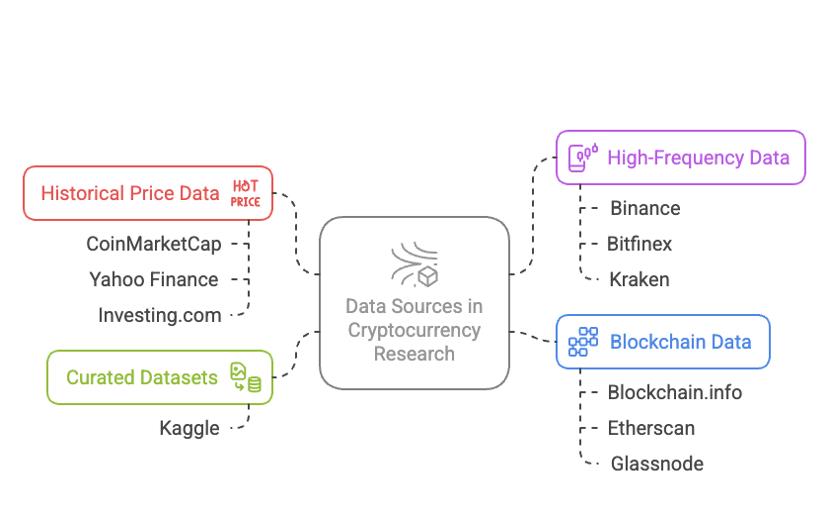
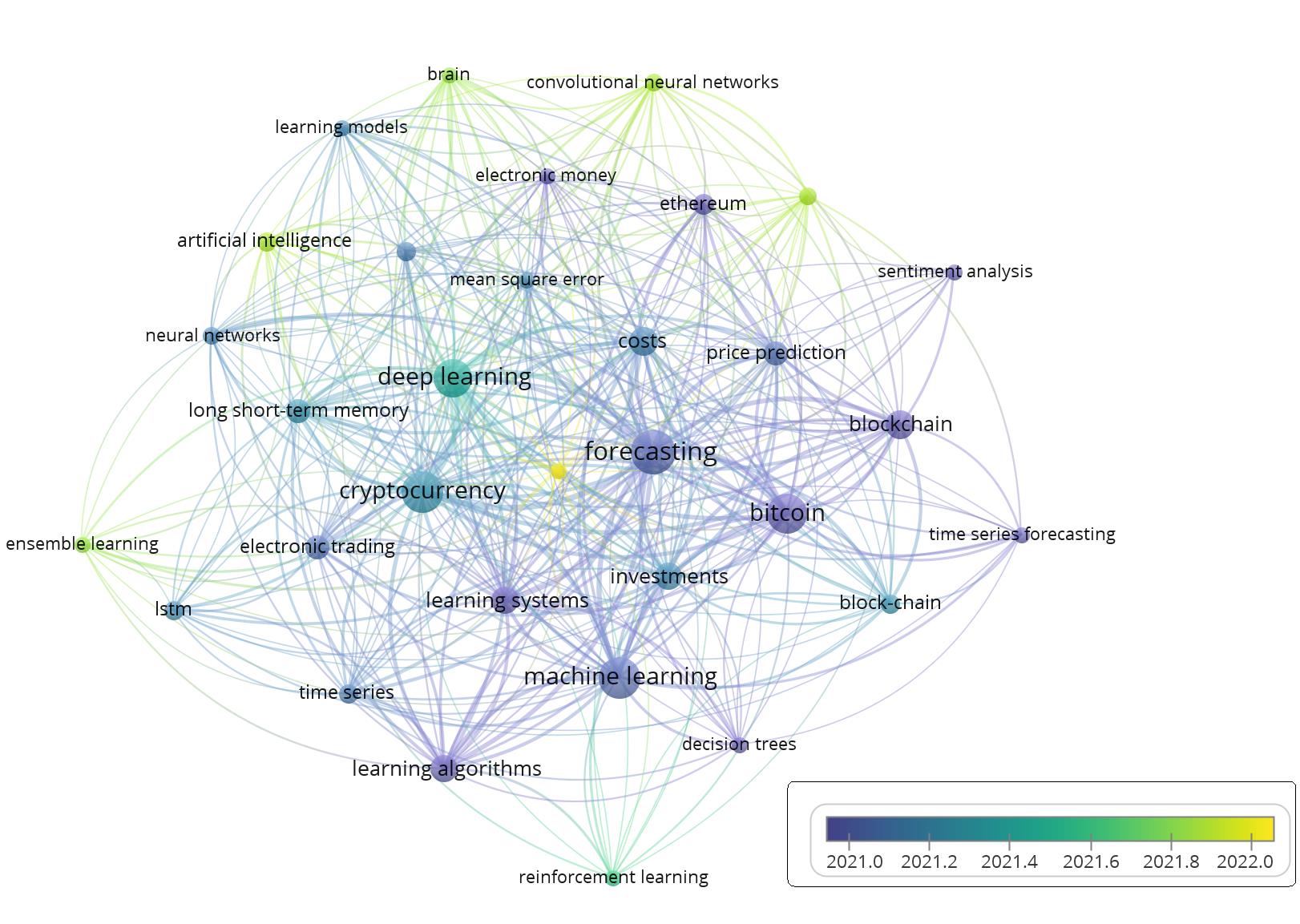
Evaluation metrics are chosen based on task type: RMSE, MAE, and MAPE dominate regression tasks, while accuracy, precision, recall, and F1 are common for classification [29], [30]. Trading performance is further assessed using ROI, Sharpe ratio, and maximum drawdown to validate real-world applicability [27], [31]. Across studies, hybrid and ensemble DL approaches, particularly those combining temporal modeling with sentiment or blockchain-derived features, deliver the strongest results. This highlights the multifactorial nature of cryptocurrency markets and the growing role of DL in capturing complex dependencies for robust prediction and trading strategies. Table 2 shows a summary of GRU and LSTM models. Figure 4 illustrates various data sources for cryptocurrency research, categorizing them into different platforms and Figure 5 shows Keywords overlay visualization using VOSviewer.
Ensemble and hybrid deep learning models
The review highlights that ensemble and hybrid DL models have gained substantial traction in cryptocurrency trading research due to their ability to improve predictive performance and robustness. Ensemble methods (such as averaging, bagging, and stacking) combine diverse models to reduce variance and increase accuracy, consistently outperforming single-model setups [6], [32]. Examples include models that integrate Artificial Neural Network (ANN), k-Nearest Neighbors (kNN), and gradient-boosted trees, or deep ensembles combining CNN, LSTM, and Bi-LSTM, all of which demonstrate lower forecasting errors and greater consistency across different cryptocurrencies [13], [32].
Hybrid approaches, in contrast, merge different DL architectures or combine DL with traditional ML/statistical methods to leverage complementary strengths. Studies show that LSTM-GRU hybrids outperform standalone LSTMs for assets like Litecoin and Monero, while models integrating autoregressive features into LSTM frameworks reduce errors in Bitcoin forecasts [33]. More advanced hybrids, such as CNN-LSTM or CNN-BiLSTM, capitalize on CNNs’ ability to capture local temporal patterns and LSTMs’ strength in modeling sequential dependencies, leading to more stable and accurate predictions [13]. Together, these ensemble and hybrid strategies represent a shift toward multi-model solutions that address the inherent volatility and complexity of crypto markets more effectively than single architectures. Table 3 shows a summary of Ensemble and Hybrid models.
Reinforcement learning for trading
This study shows a sharp rise in the use of RL and DRL for developing automated cryptocurrency trading strategies. These models operate by training agents to maximize cumulative rewards (typically expressed in profits or risk-adjusted returns) through interactions with simulated or real trading environments [34–37]. Leveraging deep neural networks, DRL agents process complex market inputs such as technical indicators, asset correlations, and portfolio positions, gradually improving their decision-making via feedback and iterative learning [35], [36], [38]. Algorithms like DQN, PPO, and Actor-Critic approaches have been widely applied, with backtesting results often showing performance superior to benchmarks such as buy-and-hold strategies [26], [38], [39]. A key strength of DRL-based trading lies in its adaptability to changing market dynamics, balancing exploration of new strategies with exploitation of proven ones [36]. Systems have reported impressive profitability, including cases where PPO-based agents and CVaR-optimized DRL portfolios achieved significantly higher returns and lower risks compared to traditional models [35], [38], [40]. Nonetheless, challenges remain (most studies rely on simulated or limited datasets, ignore external market factors, or focus narrowly on a handful of assets, which raises concerns about generalizability). More recently, researchers have begun integrating Explainable Artificial Intelligence (XAI) into DRL frameworks to improve interpretability and trust, with platforms like FinRL providing structured environments for experimentation and real-world deployment [36], [41], [42]. Table 4 shows a summary of RL for Trading.
According to Fig. 5, Each keyword is represented as a node in the network. The size of a node indicates the frequency or importance of the keyword within the dataset. Lines between nodes represent relationships or co-occurrences, with thicker lines showing stronger or more frequent connections.
External factors
The study highlights that external factors play a crucial role in enhancing the predictive power of DL models for cryptocurrency trading. Social media sentiment, particularly from platforms like Twitter and Reddit, is one of the most studied variables, as collective sentiment often drives short-term price movements. Studies consistently show that integrating sentiment indicators with technical features significantly improves prediction accuracy for assets such as Bitcoin and Ethereum [32], [43]. Similarly, on-chain data (such as transaction volume, block size, mining difficulty, and hash rate) provides insights into network activity and has been shown to serve as an early indicator of price changes [44].
Beyond sentiment and blockchain metrics, macroeconomic variables and correlated financial assets have also been incorporated into forecasting models. Factors like the S&P index, VIX, gold, interest rates, and Google Trends enrich feature sets by capturing broader market dynamics and investor behavior [16], [26], [45]. This multi-source approach consistently outperforms models based solely on historical prices, yielding more stable and reliable forecasts. Overall, the evidence suggests that combining external data with engineered technical indicators offers a more comprehensive representation of market conditions, leading to superior model performance in cryptocurrency prediction tasks [4], [43]. Table 3 shows the rule of External Data in Crypto Forecasting Models.
Table 2. Gated recurrent unit and long short-term memory model summary.
This table is shown in the PDF version of the article.
GRU, LSTM-GRU Hybrid, TCN, GRU and Hybrid models were also strong. data; no external features; limited to TFT, Ensembles (Voting Regressor) five major cryptocurrencies. [4] LSTM, GRU, Bi-LSTM Bi-LSTM outperformed others with the Relied solely on historical price data; lowest RMSE and MAPE.
BTC, ETH, and LTC.
LSTMNN; Two-stage: SVR+LSTMNN also strong.
SVR+FFNN, SVR+LSTMNN, SVR+BNN
Ref. Result [18] SAM-LSTM with CPD and on-chain data achieved best BTC price prediction (lowest MAE, RMSE); significantly outperformed single LSTM.
[22] In the post-2018 period, Gold and Oil were the most statistically accurate predictors for BTC returns.
[28] Including LDA topic weights improved prediction accuracy; model captures price trend changes well.
[42] LSTM with FS-SHAP achieved highest out-of-sample R2 for Bitcoin price prediction.
[43] DL-GuesS outperformed baseline models for Dash and Bitcoin Cash price prediction.
[32] Stacking ensemble outperformed single models; benefited from combining price, technical, and sentiment features.
[44] WT-CATCN outperformed all baseline models; best at capturing price direction and trend.
[48] ANN outperformed SVM; best performance (RMSE) achieved using macroeconomic factors.
[49] SVM robustly classified the next-day return of six major cryptocurrencies; demonstrated accurate trading strategies.
[50] Achieved up to 99% accuracy for Bitcoin and Ethereum price prediction using network features; LSTM and regression models significantly outperformed prior models.
[51] For daily price: LR and LDA outperformed ML models; for 5-min interval: LSTM outperformed statistical methods.
high accuracy but low Kappa.
ignored external factors (e.g., social media, trading volume); limited to three coins.
ignored external factors; limited to three coins.
cryptocurrencies.
cryptocurrencies; risk of overfitting.
DL models.
limited to BTC and ETH; computational constraints hindered hyperparameter optimization.
Limitation Only BTC tested; no direct comparison to other models; no external variables; generalizability not shown.
Only one-step-ahead prediction; daily data only; results sensitive to period split.
Focused mainly on Bitcoin and one forum; limited external validation.
Only daily data; limited to Bitcoin; model performance may vary.
Only tested on Dash and Bitcoin Cash; tweet sample limited; short prediction window.
Only Bitcoin analyzed; Twitter data may be noisy; generalizability not tested.
Only Bitcoin tested; daily data only; generalizability not shown.
Only ANN and SVM tested; no social data; limited to four coins.
Only six cryptocurrencies; limited to daily data; model focuses on classification.
Only internal features used; limited to two cryptocurrencies; random sampling gives higher accuracy.
Limited feature sets; did not test all ML algorithms; results may not generalize.
limited window.
[5] LSTM, GRU, Bi-LSTM GRU achieved the best performance for Relied solely on historical price data;
[14] LSTM Achieved superior performance with low Excluded external factors like MSE/RMSE/NRMSE across all coins. sentiment analysis; tested on only four
[26] Simple NN, LSTM, GRU, GRU GRU with recurrent dropout achieved the Focused only on Bitcoin; shortterm with recurrent dropout lowest RMSE and outperformed LSTM. predictions; not tested on other
[46] LSTM, GRU GRU generally outperformed LSTM in Focused solely on Bitcoin; did not most forecasting windows; LSTM slightly include other cryptocurrencies or better for 7-day ahead prediction. external factors; compared only two
[47] One-stage: BNN, FFNN, Best performance from BNN; two-stage Used only five technical indicators;
Table 3. External data in crypto forecasting models.
This table is shown in the PDF version of the article.
[52] MLP achieved the best balance of accuracy and Kappa; Naive Bayes Only transaction metadata used; class imbalance; [53] Unrestricted models significantly outperformed restricted; Only two cryptocurrencies; only direction predicted; social best hourly result: CNN (accuracy). indicators less effective at hourly frequency.
[54] SVM was most accurate for predicting next-day BTC price Only BTC studied; only English news headlines; better at direction; news sentiment yielded highest accuracy. predicting up moves.
[55] Both models achieved very low MSE for next-day BTC price Only BTC studied; limited to two financial and two prediction; ARIMAX outperformed LSTM. sentiment features.
[56] R-DB-LM-NN achieved the lowest prediction errors for Limited to short-term prediction; only tested on Bitcoin.
Bitcoin closing price.
[57] Including attention variables improved LSTM’s prediction Only Bitcoin analyzed; daily data only; model performance accuracy for Bitcoin returns. depends on input selection.
Table 4. Ensemble and hybrid modeling summary.
This table is shown in the PDF version of the article.
[6] Ensemble DL stacking with meta-learners had best regression (lowest RMSE); Bagging and Averaging had best classification accuracy (XRP).
Ensembles outperformed single DL models.
[7] WAMC (GRU + self-attention + channel weighting + CNN pooling) achieved stateof-the-art results: lowest RMSE, MAE, MAPE, highest R2, best classification accuracy, and investment return. Outperformed ARIMA, SVR, RF, XGB, MLP, LSTM, GRU, CNN, and hybrid models.
[8] CNN-LSTM and CNN-BiLSTM slightly outperformed others for BTC, ETH, XRP (lowest RMSE and highest accuracy/F1), but improvement over ML models was minimal.
[13] Ensemble DL (Averaging, Bagging, Stacking) with CNN-LSTM and CNN-BiLSTM base models achieved the best regression (lowest RMSE) and classification accuracy. Ensembles outperformed single DL models in both tasks.
[15] LightGBM and AdaBoost performed best for BTC/ETH regression and investor metrics. Simple RNN led for Ripple. Ensemble/DL models outperformed traditional models.
[20] 1D CNN + Stacked GRU (1DCNN-GRU) outperformed all compared methods with lowest RMSE.
[30] Multi-Input CNN-LSTM improved directional accuracy (GM, Sensitivity, Specificity, AUC); regression performance similar to single-input models.
Reduced overfitting, lower computation cost.
[33] Hybrid model (LSTM and GRU) achieved significantly lower prediction errors than LSTM alone for Litecoin and Monero. Consistently outperformed LSTM.
[39] Proposed RNN-LSTM model outperformed ARIMA, SVR, RF, XGB, MLP, LSTM, GRU, CNN, LSTM+CNN, GRU+CNN; achieved lowest RMSE, MAPE, and highest R2 for ETH.
[58] Best daily regression: LSTM-GRU hybrid. Best classification: Ensemble.
Best weekly regression: TCN. Hybrid/ensemble models outperformed single models.
Limitation Only historical price data used; limited to three coins; ignores external factors; high computational cost; less suitable for realtime/high-frequency use.
Only four cryptocurrencies; uses only historical price data; short input window; not tested on other markets.
Only price data used; limited to three coins; no external features; short time span; residuals showed autocorrelation; DL not significantly better than ML baselines.
Only historical price data used; limited to three coins; ignores external factors (news, volume, sentiment); short-term (hourly) focus.
Only univariate price data; limited to four coins; generalizability to other assets or multivariate settings uncertain; overfitting risk; strategies not tested live.
Only one week of data used due to computational constraints; only closing price as input; ignores external factors (e.g., news, sentiment, macro trends).
Only price data; limited to three coins; no external inputs; short time span; not tested on high-frequency or more coins.
Only historical price data used; tested on two coins; prediction accuracy drops for longer horizons; model may not generalize well. Only four cryptocurrencies; limited to price/volume data; ignores external factors (e.g., news, sentiment, macro trends). Only Ether considered; limited forecast horizon; no external macro/news data; weekly prediction remains challenging.
Table 5. Reinforcement learning for trading.
This table is shown in the PDF version of the article.
[29] RL-based system outperformed Only two cryptocurrencies; dataset not public; ignores some external factors; state-ofthe-art algorithms for generalizability not tested.
Litecoin and Monero price prediction; predicted trends closely matched actual prices.
[34] Direct RL with Sortino Performance varies by asset; black-box nature of the model; ignores microstructure optimization outperformed variables.
buyand-hold in 4/5 cryptocurrencies; reduced downside risk.
[35] DRL agent achieved 114.4% Only price data used; performance depends on market conditions; tested on a limited profit in one month for Bitcoin; asset set.
consistently outperformed classical strategies.
[36] FinRL framework enables No novel algorithm proposed; performance dependent on selected DRL method; implementation of DRL trading practical deployment may face real-world constraints.
agents that can outperform conventional baselines.
[38] PPO-based agent achieved a Only single asset (Bitcoin); simulated environment; results may not generalize to live 341.28% profit rate on test set, trading.
outperforming all benchmark trading strategies.
[40] CVaR-based DRL portfolios Only price data used; limited to six major cryptocurrencies; model complexity poses outperformed mean-variance implementation challenges.
portfolios with higher returns, lower risk, and better out-of-sample performance.
4. Discussion
This study shows the growing reliance on DL to address the complexities of cryptocurrency markets. Early research largely compared statistical approaches such as ARIMA and GARCH with emerging ML methods, but recent work shows a clear shift toward DL architectures better suited for non-linear and sequential data. RNNs, particularly LSTM and GRU models, dominate the field, with extensions like Bi-LSTM and hybrid models combining CNNs and RNNs offering improved temporal and contextual learning. Attention mechanisms and ensemble methods further enhance predictive performance, with studies reporting mixed but often superior results compared to traditional benchmarks. Despite these advancements, challenges remain due to the volatility and near-random walk behavior of cryptocurrency prices, which limit long-term forecasting accuracy. While some models achieve notable improvements, performance often varies by dataset, asset type, and evaluation metric, highlighting the complexity of the problem. Future research directions include developing more robust and generalizable architectures, incorporating diverse data sources such as on-chain metrics and macroeconomic indicators, and applying explainable AI for transparency in decision-making. Additional priorities involve addressing regulatory impacts, computational efficiency for real-time trading, and expanding applications to risk management and anomaly detection. Collectively, these efforts aim to enhance both predictive accuracy and the practical usability of DL in cryptocurrency markets.
Limitations
Cryptocurrency price prediction faces significant challenges due to the market’s high volatility, immaturity, and complex dynamics, which can make prices behave like a near-random walk. Accurate forecasting is difficult even with advanced methods, particularly for capturing extreme price movements or long-term trends. Data collection and feature selection are major hurdles, as models must integrate diverse inputs (including historical prices, technical indicators, social media sentiment, blockchain data, macroeconomic factors, and intercryptocurrency relationships) while handling issues like correlated features, limited availability, and qualitative nuances. Model limitations further complicate prediction: even sophisticated DL architectures like LSTMs and CNNs may be inefficient or unreliable, and many suffer from limited interpretability. Reproducibility is a persistent concern due to incomplete documentation of parameters and implementation details. Evaluating performance is challenging as conventional metrics (MAE, RMSE) may not reflect directional accuracy, and back-testing simulations can be unrealistic or computationally intensive. When applied to trading strategies, additional constraints arise, such as ignoring transaction costs, relying on idealized market assumptions, finite data samples, and the need to generalize across different assets or exchanges. Collectively, these factors highlight the need for more robust methodologies, improved evaluation frameworks, and cautious interpretation of results for real-world application.
Future directions
Future research in DL for cryptocurrency markets should focus on developing more robust and generalizable models that can adapt to different cryptocurrencies, exchanges, and rapidly changing market conditions, addressing challenges like high volatility and regime shifts [1], [4], [8], [25], [59], [60]. Incorporating diverse and high-quality data sources (including on-chain metrics, social media sentiment, macroeconomic indicators, and alternative financial signals) can enhance predictive performance, but requires sophisticated feature selection and data fusion techniques to manage heterogeneous inputs effectively [28], [42], [43], [32], [48], [61]. Advanced model architectures, such as hybrid and ensemble systems combining RNNs, CNNs, attention mechanisms, and Transformers like the Temporal Fusion Transformer (TFT), offer promise for capturing complex temporal dependencies and improving forecasting accuracy [1], [5–7], [20], [27], [30], [62], [49]. Additionally, ensuring transparency and trust in model predictions through explainable AI techniques is critical for investors, regulators, and practitioners, addressing the “black-box” nature of DL models. Practical deployment considerations, such as evaluating risk-adjusted returns, transaction costs, liquidity constraints, and computational efficiency for real-time or high-frequency trading, are essential to bridge the gap between academic research and realworld application [20], [23], [27], [31], [63]. Extending applications to risk management, anomaly detection, and incorporating the impacts of market structure, regulation, and macroeconomic factors further broadens the potential of DL to provide actionable insights in the dynamic and complex cryptocurrency ecosystem [25], [59], [43], [60], [48], [64].
5. Conclusion
This study shows the growing adoption of DL techniques in cryptocurrency forecasting and trading. Recurrent models such as LSTMs and GRUs, alongside CNNs and Bi-LSTMs, dominate the literature, particularly in studies on Bitcoin, Ethereum, and Litecoin. Their applications extend beyond price prediction to volatility estimation, trading strategy development, and portfolio optimization. A notable trend is the integration of alternative data (technical indicators, on-chain metrics, and social media sentiment) which consistently enhances model performance. Compared to traditional statistical approaches like ARIMA and ML methods such as SVMs or Random Forests, DL models achieve lower prediction errors and higher directional accuracy. Ensemble approaches further improve robustness and predictive power. Despite these advances, challenges remain due to the volatility, complexity, and potential near-random walk behavior of cryptocurrency markets. Future work must focus on designing architectures that better capture dynamic dependencies and adapt to rapidly shifting conditions. Greater emphasis on explainability (XAI) will improve interpretability and trust in model outputs. Expanding research to include more diverse cryptocurrencies, accounting for regulatory and macroeconomic influences, and evaluating real-world profitability under realistic trading constraints (e.g., transaction costs and liquidity) will be critical to translating DL advances into practical, reliable trading solutions.
Acknowledgments
The authors would like to express their sincere gratitude to the editors and anonymous reviewers for their invaluable comments and constructive feedback, which significantly contributed to the enhancement of this paper.
Author Contribution
Saeid Ataei: Methodology, software, and editing. Seyyed Taghi Ataei: Conceptualization. Parisa Omidmand: Writing and editing. Hoora Hajian Karahroodi: Writing and editing. Pegah Nikza: Writing and editing. All authors have read and agreed to the published version of the manuscript.
Funding
The authors declare that no external funding or support was received for the research presented in this paper, including administrative, technical, or in-kind contributions.
Data Availability
All data supporting the reported findings in this research paper are provided within the manuscript.
Conflicts of Interest
The authors declare that there is no conflict of interest concerning the reported research findings.
Figures
References
- [1] Murray, K., Rossi, A., Carraro, D., & Visentin, A. (2023). On forecasting cryptocurrency prices: A comparison of machine learning, deep learning, and ensembles. Forecasting, 5(1), 196–209. https://doi.org/10.3390/forecast5010010
- [2] Khedmati, M., Seifi, F., & Azizi, M. J. (2020). Time series forecasting of bitcoin price based on autoregressive integrated moving average and machine learning approaches. International journal of engineering, 33(7), 1293–1303. https://www.researchgate.net/publication/350007539
- [3] Akyildirim, E., Goncu, A., & Sensoy, A. (2021). Prediction of cryptocurrency returns using machine learning. Annals of operations research, 297(1), 3–36. https://doi.org/10.1007/s10479-020-03575-y
- [4] Seabe, P. L., Moutsinga, C. R. B., & Pindza, E. (2023). Forecasting cryptocurrency prices using LSTM, GRU, and Bi-Directional LSTM: A deep learning approach. Fractal and fractional, 7(2), 1–18. https://doi.org/10.3390/fractalfract7020203
- [5] Hamayel, M. J., & Owda, A. Y. (2021). A novel cryptocurrency price prediction model using GRU, LSTM and bi-LSTM machine learning algorithms. AI, 2(4), 477–496. https://doi.org/10.3390/ai2040030
- [6] Livieris, I. E., Pintelas, E., Stavroyiannis, S., & Pintelas, P. (2020). Ensemble deep learning models for forecasting cryptocurrency time-series. Algorithms, 13(5), 1–21. https://doi.org/10.3390/a13050121
- [7] Zhang, Z., Dai, H. N., Zhou, J., Mondal, S. K., García, M. M., & Wang, H. (2021). Forecasting cryptocurrency price using convolutional neural networks with weighted and attentive memory channels. Expert systems with applications, 183, 115378. https://doi.org/10.1016/j.eswa.2021.115378
- [8] Pintelas, E., Livieris, I. E., Stavroyiannis, S., Kotsilieris, T., & Pintelas, P. (2020). Investigating the problem of cryptocurrency price prediction: A deep learning approach. Artificial intelligence applications and innovations (pp. 99–110). Cham: Springer International Publishing. https://doi.org/10.1007/978-3-030-49186-4_9
- [9] John, D. L., Binnewies, S., & Stantic, B. (2024). Cryptocurrency price prediction algorithms: A survey and future directions. Forecasting, 6(3), 637–671. https://doi.org/10.3390/forecast6030034
- [10] Mienye, E., Jere, N., Obaido, G., Mienye, I. D., & Aruleba, K. (2024). Deep learning in finance: A survey of applications and techniques. AI, 5(4), 2066–2091. https://doi.org/10.3390/ai5040101
- [11] Mohammadshafie, A., Mirzaeinia, A., Jumakhan, H., & Mirzaeinia, A. (2025). Deep reinforcement learning strategies in finance: Insights into asset holding, trading behavior, and purchase diversity. Artificial intelligence and applications (pp. 449–463). Cham: Springer Nature Switzerland. https://doi.org/10.1007/978-3-031-86623-4_41
- [12] Pippas, N., Ludvig, E. A., & Turkay, C. (2025). The evolution of reinforcement learning in quantitative finance: A Survey. ACM computing surveys, 57(11), 1–15. https://doi.org/10.1145/3733714
- [13] Rao, K. R., Prasad, M. L., Kumar, G. R., Natchadalingam, R., Hussain, M. M., & Reddy, P. C. S. (2023). Time-series cryptocurrency forecasting using ensemble deep learning. 2023 international conference on circuit power and computing technologies (ICCPCT) (pp. 1446–1451). IEEE. https://doi.org/10.1109/ICCPCT58313.2023.10245083
- [14] Ammer, M. A., & Aldhyani, T. H. H. (2022). Deep learning algorithm to predict cryptocurrency fluctuation prices: Increasing investment awareness. Electronics, 11(15), 1–22. https://doi.org/10.3390/electronics11152349
- [15] Bouteska, A., Abedin, M. Z., Hajek, P., & Yuan, K. (2024). Cryptocurrency price forecasting – A comparative analysis of ensemble learning and deep learning methods. International review of financial analysis, 92, 103055. https://doi.org/10.1016/j.irfa.2023.103055
- [16] Liu, M., Li, G., Li, J., Zhu, X., & Yao, Y. (2021). Forecasting the price of Bitcoin using deep learning. Finance research letters, 40, 101755. https://doi.org/10.1016/j.frl.2020.101755
- [17] Lamothe-Fernández, P., Alaminos, D., Lamothe-López, P., & Fernández-Gámez, M. A. (2020). Deep learning methods for modeling bitcoin price. Mathematics, 8(8), 1–13. https://doi.org/10.3390/math8081245
- [18] Kim, G., Shin, D. H., Choi, J. G., & Lim, S. (2022). A Deep learning-based cryptocurrency price prediction model that uses on-chain data. IEEE access, 10, 56232–56248. https://doi.org/10.1109/ACCESS.2022.3177888
- [19] Akyildirim, E., Cepni, O., Corbet, S., & Uddin, G. S. (2023). Forecasting mid-price movement of Bitcoin futures using machine learning. Annals of operations research, 330(1), 553–584. https://doi.org/10.1007/s10479-021-04205-x
- [20] Kang, C. Y., Lee, C. P., & Lim, K. M. (2022). Cryptocurrency price prediction with convolutional neural network and stacked gated recurrent unit. Data, 7(11), 1–13. https://doi.org/10.3390/data7110149
- [21] Liu, Y., Li, Z., Nekhili, R., & Sultan, J. (2023). Forecasting cryptocurrency returns with machine learning. Research in international business and finance, 64, 101905. https://doi.org/10.1016/j.ribaf.2023.101905
- [22] Parvini, N., Abdollahi, M., Seifollahi, S., & Ahmadian, D. (2022). Forecasting Bitcoin returns with long short-term memory networks and wavelet decomposition: A comparison of several market determinants. Applied soft computing, 121, 108707. https://doi.org/10.1016/j.asoc.2022.108707
- [23] Zoumpekas, T., Houstis, E., & Vavalis, M. (2020). ETH analysis and predictions utilizing deep learning. Expert systems with applications, 162, 113866. https://doi.org/10.1016/j.eswa.2020.113866
- [24] Sebastião, H., & Godinho, P. (2021). Forecasting and trading cryptocurrencies with machine learning under changing market conditions. Financial innovation, 7(1), 1–33. https://doi.org/10.1186/s40854-020-00217-x
- [25] Uras, N., Marchesi, L., Marchesi, M., & Tonelli, R. (2020). Forecasting Bitcoin closing price series using linear regression and neural networks models. PeerJ computer science, 6, e279. https://doi.org/10.7717/peerj-cs.279
- [26] Dutta, A., Kumar, S., & Basu, M. (2020). A gated recurrent unit approach to bitcoin price prediction. Journal of risk and financial management, 13(2), 1–16. https://doi.org/10.3390/jrfm13020023
- [27] Borges, T. A., & Neves, R. F. (2020). Ensemble of machine learning algorithms for cryptocurrency investment with different data resampling methods. Applied soft computing, 90, 106187. https://doi.org/10.1016/j.asoc.2020.106187
- [28] M., P., Nguyen, T. N., Hamdi, M., & Cengiz, K. (2021). Global cryptocurrency trend prediction using social media. Information processing & management, 58(6), 102708. https://doi.org/10.1016/j.ipm.2021.102708
- [29] Shahbazi, Z., & Byun, Y. C. (2021). Improving the cryptocurrency price prediction performance based on reinforcement learning. IEEE access, 9, 162651–162659. https://doi.org/10.1109/ACCESS.2021.3133937
- [30] Livieris, I. E., Kiriakidou, N., Stavroyiannis, S., & Pintelas, P. (2021). An advanced CNN-LSTM model for cryptocurrency forecasting. Electronics, 10(3), 1–16. https://doi.org/10.3390/electronics10030287
- [31] Jaquart, P., Köpke, S., & Weinhardt, C. (2022). Machine learning for cryptocurrency market prediction and trading. The journal of finance and data science, 8, 331–352. https://doi.org/10.1016/j.jfds.2022.12.001
- [32] Ye, Z., Wu, Y., Chen, H., Pan, Y., & Jiang, Q. (2022). A stacking ensemble deep learning model for bitcoin price prediction using twitter comments on Bitcoin. Mathematics, 10(8), 1–21. https://doi.org/10.3390/math10081307
- [33] Patel, M. M., Tanwar, S., Gupta, R., & Kumar, N. (2020). A deep learning-based cryptocurrency price prediction scheme for financial institutions. Journal of information security and applications, 55, 102583. https://doi.org/10.1016/j.jisa.2020.102583
- [34] Koker, T. E., & Koutmos, D. (2020). Cryptocurrency trading using machine learning: A Technical note. Journal of risk and financial management, 13(8), 1–7. https://doi.org/10.3390/jrfm13080178
- [35] Sattarov, O., Muminov, A., Lee, C. W., Kang, H. K., Oh, R., Ahn, J., … ., & Jeon, H. S. (2020). Recommending cryptocurrency trading points with deep reinforcement learning approach. Applied sciences, 10(4), 1–18. https://doi.org/10.3390/app10041506
- [36] Liu, X. Y., Yang, H., Gao, J., & Wang, C. D. (2021). FinRL: Deep reinforcement learning framework to automate trading in quantitative finance. Proceedings of the second ACM international conference on AI in finance (pp. 1–9). Association for computing machinery. https://doi.org/10.1145/3490354.3494366
- [37] Schnaubelt, M. (2022). Deep reinforcement learning for the optimal placement of cryptocurrency limit orders. European journal of operational research, 296(3), 993–1006. https://doi.org/10.1016/j.ejor.2021.04.050
- [38] Liu, F., Li, Y., Li, B., Li, J., & Xie, H. (2021). Bitcoin transaction strategy construction based on deep reinforcement learning. Applied soft computing, 113, 107952. https://doi.org/10.1016/j.asoc.2021.107952
- [39] Nasirtafreshi, I. (2022). Forecasting cryptocurrency prices using recurrent neural network and long short-term memory. Data & knowledge engineering, 139, 102009. https://doi.org/10.1016/j.datak.2022.102009
- [40] Cui, T., Ding, S., Jin, H., & Zhang, Y. (2023). Portfolio constructions in cryptocurrency market: A CVaR-based deep reinforcement learning approach. Economic modelling, 119, 106078. https://doi.org/10.1016/j.econmod.2022.106078
- [41] Babaei, G., Giudici, P., & Raffinetti, E. (2022). Explainable artificial intelligence for crypto asset allocation. Finance research letters, 47, 102941. https://doi.org/10.1016/j.frl.2022.102941
- [42] Goodell, J. W., Ben Jabeur, S., Saâdaoui, F., & Nasir, M. A. (2023). Explainable artificial intelligence modeling to forecast bitcoin prices. International review of financial analysis, 88, 102702. https://doi.org/10.1016/j.irfa.2023.102702
- [43] Parekh, R., Patel, N. P., Thakkar, N., Gupta, R., Tanwar, S., Sharma, G., … ., & Sharma, R. (2022). DL-GuesS: Deep learning and sentiment analysis-based cryptocurrency price prediction. IEEE access, 10, 35398–35409. https://doi.org/10.1109/ACCESS.2022.3163305
- [44] Guo, H., Zhang, D., Liu, S., Wang, L., & Ding, Y. (2021). Bitcoin price forecasting: A perspective of underlying blockchain transactions. Decision support systems, 151, 113650. https://doi.org/10.1016/j.dss.2021.113650
- [45] Erfanian, S., Zhou, Y., Razzaq, A., Abbas, A., Safeer, A. A., & Li, T. (2022). Predicting Bitcoin (BTC) Price in the context of economic theories: A machine learning approach. Entropy, 24(10), 1–29. https://doi.org/10.3390/e24101487
- [46] Awoke, T., Rout, M., Mohanty, L., & Satapathy, S. C. (2021). Bitcoin price prediction and analysis using deep learning models. Communication software and networks (pp. 631–640). Singapore: Springer Singapore. https://doi.org/10.1007/978-981-15-5397-4_63
- [47] Cocco, L., Tonelli, R., & Marchesi, M. (2021). Predictions of bitcoin prices through machine learning based frameworks. PeerJ computer science, 7, e413. https://doi.org/10.7717/peerj-cs.413
- [48] Kim, H. M., Bock, G. W., & Lee, G. (2021). Predicting Ethereum prices with machine learning based on Blockchain information. Expert systems with applications, 184, 115480. https://doi.org/10.1016/j.eswa.2021.115480
- [49] Mahdi, E., Leiva, V., Mara’Beh, S., & Martin-Barreiro, C. (2021). A new approach to predicting cryptocurrency returns based on the gold prices with support vector machines during the COVID-19 pandemic using sensor-related data. Sensors, 21(18), 1–16. https://doi.org/10.3390/s21186319
- [50] Saad, M., Choi, J., Nyang, D., Kim, J., & Mohaisen, A. (2020). Toward characterizing blockchain-based cryptocurrencies for highly accurate predictions. IEEE systems journal, 14(1), 321–332. https://doi.org/10.1109/JSYST.2019.2927707
- [51] Chen, Z., Li, C., & Sun, W. (2020). Bitcoin price prediction using machine learning: An approach to sample dimension engineering. Journal of computational and applied mathematics, 365, 112395. https://doi.org/10.1016/j.cam.2019.112395
- [52] Singh, H. J., & Hafid, A. S. (2020). Prediction of transaction confirmation time in ethereum blockchain using machine learning. Blockchain and applications (pp. 126–133). Cham: Springer International Publishing. https://doi.org/10.1007/978-3-030-23813-1_16
- [53] Ortu, M., Uras, N., Conversano, C., Bartolucci, S., & Destefanis, G. (2022). On technical trading and social media indicators for cryptocurrency price classification through deep learning. Expert systems with applications, 198, 116804. https://doi.org/10.1016/j.eswa.2022.116804
- [54] Gurrib, I., & Kamalov, F. (2021). Predicting bitcoin price movements using sentiment analysis: a machine learning approach. Studies in economics and finance, 39(3), 347–364. https://doi.org/10.1108/SEF-07-2021-
- [55] Serafini, G., Yi, P., Zhang, Q., Brambilla, M., Wang, J., Hu, Y., & Li, B. (2020). Sentiment-driven price prediction of the bitcoin based on statistical and deep learning approaches. 2020 international joint conference on neural networks (IJCNN) (pp. 1–8). IEEE. https://doi.org/10.1109/IJCNN48605.2020.9206704
- [56] Shang, D., Yan, Z., Zhang, L., & Cui, Z. (2023). Digital financial asset price fluctuation forecasting in digital economy era using blockchain information: A reconstructed dynamic-bound Levenberg– Marquardt neural-network approach. Expert systems with applications, 228, 120329. https://doi.org/10.1016/j.eswa.2023.120329
- [57] Wang, C., Shen, D., & Li, Y. (2022). Aggregate investor attention and bitcoin return: The long short-term memory networks perspective. Finance research letters, 49, 103143. https://doi.org/10.1016/j.frl.2022.103143
- [58] Politis, A., Doka, K., & Koziris, N. (2021). Ether price prediction using advanced deep learning models. 2021 ieee international conference on blockchain and cryptocurrency (ICBC) (pp. 1–3). IEEE. https://doi.org/10.1109/ICBC51069.2021.9461061
- [59] Tanwar, S., Patel, N. P., Patel, S. N., Patel, J. R., Sharma, G., & Davidson, I. E. (2021). Deep learning-based cryptocurrency price prediction scheme with inter-dependent relations. IEEE access, 9, 138633–138646. https://doi.org/10.1109/ACCESS.2021.3117848
- [60] Oyedele, A. A., Ajayi, A. O., Oyedele, L. O., Bello, S. A., & Jimoh, K. O. (2023). Performance evaluation of deep learning and boosted trees for cryptocurrency closing price prediction. Expert systems with applications, 213, 119233. https://doi.org/10.1016/j.eswa.2022.119233
- [61] Gurdgiev, C., & O’Loughlin, D. (2020). Herding and anchoring in cryptocurrency markets: Investor reaction to fear and uncertainty. Journal of behavioral and experimental finance, 25, 100271. https://doi.org/10.1016/j.jbef.2020.100271
- [62] Lahmiri, S., & Bekiros, S. (2020). Intelligent forecasting with machine learning trading systems in chaotic intraday Bitcoin market. Chaos, solitons & fractals, 133, 109641. https://doi.org/10.1016/j.chaos.2020.109641
- [63] Vo, A., & Yost-Bremm, C. (2020). A high-frequency algorithmic trading strategy for cryptocurrency. Journal of computer information systems, 60(6), 555–568. https://doi.org/10.1080/08874417.2018.1552090
- [64] Aras, S. (2021). Stacking hybrid GARCH models for forecasting Bitcoin volatility. Expert systems with applications, 174, 114747. https://doi.org/10.1016/j.eswa.2021.114747