
On Analysis of Development of an Infectious Disease in the Development of an Organism
Abstract
In this paper we analyzed the development of an infectious disease in a population of organisms. We consider a model for prediction the development of an infectious disease in a population of organisms. We introduced an analytical approach to analyze the considered model. We also consider changing of the pace of development of the epidemic.
Keywords:Development of an infectious diseaseModel of processAnalytical approach for analysis
1. Introduction
The infectious process is a complex multicomponent process of dynamic interaction of infectious pathogenic agents with a macroorganism, characterized by the development of a complex of typical pathological reactions, systemic functional changes, hormonal status disorders, specific immunological defense mechanisms and nonspecific resistance factors [1–5]. The infectious process is the basis for the development of infectious diseases. The practical significance of knowing the etiology and pathogenesis of infectious diseases, the general patterns of their development is due to the fact that infectious diseases for a long time occupy the third place in prevalence after diseases of the cardiovascular system and oncological pathology. Despite the solution of the problem of prevention and treatment of a number of infections and, accordingly, a sharp decrease in the incidence of smallpox, malaria, diphtheria, plague, cholera and other forms of infectious pathology, other problems of the epidemiology and treatment of infectious diseases initiated by other pathogens come to the fore. In this paper, we consider a model for predicting the development of an infectious disease in a population of organisms and analyze it. We introduced an analytical approach to analyze the considered model. We formulate conditions to accelerate and slow down the development of an infectious disease.
2. Method of Solution
In this section we consider the following model based on solution of the following system of ordinary differential equations.
where S(t) is the number of organisms susceptible to infection; I(t) is the the number of asymptomatically infected organisms; R(t) is the number of infected organisms with associated symptoms; U(t) is the number of infected organisms with relevant symptoms but not reported; t is the current time; is the delay; (t), (t), (t), (t), i(t) are the parameters of the system. Initial conditions for the functions S(t), I(t), R(t) and U(t) could be written as
S (0) = S0, I (0) = I0, R (0) = R0, U (0) = U0. (2)
We solved the system of Eqs. (1) by the method of averaging of functional corrections [6], [7]. In the framework of the considered method we replace the required functions on their not yet known average values 1 in right sides of the Eqs. (1). Next integration of the obtained relations on time leads to the following relations to determine the first-order approximations of the required functions in the following form
Not yet known average values were determine by the following standard relation [6], [7].
Substitution of Relations (3) into Relation (4) and solution of obtained equations gives a possibility to obtain The second-order approximations were determined by replacement by required functions on the following sum (t) 2+1(t) in the right sides of Eqs. (1). The replacement and integration of the obtained relations on time gives a possibility to obtain the second-order approximations of the required functions in the following form
Average values of the second-order approximations of the required functions were determined by the following standard relations [6], [7].
Substitution of Relation (6) into Relation (7) and solution of the obtained equations gives a possibility to obtain Functions S(t), I(t), R(t) and U(t) were analyzed analytically by using the second-order approximations in the framework of method of averaging of function corrections. The approximation is usually enough good approximation for to make qualitative analysis and to obtain some quantitative results. All obtained results have been checked by comparison with results of numerical simulations.
3. Discussion
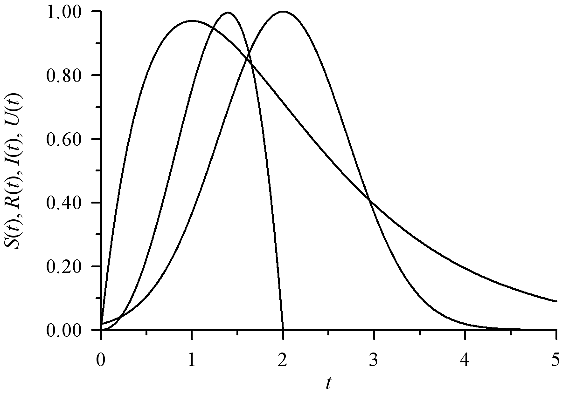
In this section we analyzed changing in time of the functions S(t), I(t), R(t) and U(t). The figure below shows typical dependencies of the considered numbers of organisms. Changing of values of parameters of the considered model leads to appropriate changes of the considered functions. These relationships show that epidemics can occur and then end due to anti-epidemic measures or the extinction of a population of organisms.
4. Conclusion
We analyzed development of an infectious disease in a population of organisms. It has been considered model for predicting of development of the infectious disease in the population of organisms. We also introduce an analytical approach to analyze the considered model. We also consider changing of the pace of development of the epidemic.
Authors' Contributions
All aspects of the research and manuscript preparation were carried out by the author. The author has read and approved the final version of the manuscript.
Funding
Not applicable.
Data Availability
All data supporting the reported findings in this research paper are provided within the manuscript.
Conflict of Interest
The author declares that they do not have any conflict of interest.
Consent for Publication
The author confirms consent for the publication of this work
Ethics Approval and Consent to Participate
This article does not contain any studies with human participants performed by the author.
References
- [1] Liu, Z., Magal, P., Seydi, O., & Webb, G. (2020). A COVID-19 epidemic model with latency period. Infectious disease modelling, 5, 323–337. https://doi.org/10.1016/j.idm.2020.03.003
- [2] Wismont, A. F., & Wismont, F. I. (2017). Infectious process (Учебно-методическое пособие). Minsk: Belarusian State Medical University. https://dokumen.pub/f73804ea4850827f08c99ec8bedb7a8b.html
- [3] Goloverova, Y., Marin, G., Golubcova, A., Shabalina, S., & Romanova, K. (2020). The relevance of the risk of prevalence of infections associated with the provision of medical care among medical professionals at the present stage. Infectious diseases, 18(1), 60–66. https://doi.org/10.20953/1729-9225-2020-1-60-66
- [4] Petrov, A. A., Lebedev, V. N., Sizikova, T. E., Plekhanova, T. M., & Borisevich, S. V. (2019). Analysis of using of antisense oligonucleotides for the prevention and treatment of dangerous and especially dangerous viral infectious diseases. Antibiotics and chemotherapy, 64(7–8), 56-62. (In Russian). https://doi.org/10.24411/0235-2990-2019-100045
- [5] Ismailova, A., & White, J. H. (2022). Vitamin D, infections and immunity. Reviews in endocrine & metabolic disorders, 23(2), 265–277. https://doi.org/10.1007/s11154-021-09679-5
- [6] Arnold, R. N., Bycroft, G. N., & Warburton, G. B. (2021). Forced vibrations of a body on an infinite elastic solid. Journal of applied mechanics, 22(3), 391–400. https://doi.org/10.1115/1.4011096
- [7] Pankratov, E. L., & Bulaeva, E. A. (2015). On optimization of regimes of epitaxy from gas phase. Some analytical approaches to model physical processes in reactors for epitaxy from gas phase during growth films. Reviews in theoretical science, 3(4), 365–398.